What Is Software Productivity Explained
For a long time, the software world has wrestled with a tricky question: what does it actually mean to be “productive”? The old-school approach was to count things. Easy things. Managers would track lines of code, hours logged, or bugs squashed.
But this created a warped reality. A developer who cleverly solved a tough problem with just 10 lines of code looked less productive than someone who churned out 100 lines of messy, bug-ridden code. It was a classic case of rewarding activity, not accomplishment.
Defining Real Software Productivity

This old way of thinking is like judging a chef by the number of pans they dirtied instead of the taste of the final dish. It’s a broken model that leads straight to developer burnout, encourages the wrong kind of work, and completely misses the connection between engineering effort and business results.
Moving from Output to Outcomes
Thankfully, the industry is moving past this factory-floor mentality. We now understand that real productivity is about delivering value. It’s a delicate balance of speed, stability, and genuine business impact. It’s not just about the code; it’s about the entire journey from a spark of an idea to a working feature in a user’s hands.
This modern view is built on a few core ideas that go far beyond simple metrics.
Modern Pillars of Software Productivity
To truly grasp productivity today, we need to look at the whole picture. The table below breaks down the essential components that define a high-performing software team.
| Pillar | Description |
|---|---|
| Speed and Efficiency | How fast can we get an idea into production? This is all about cutting out the fat and smoothing the path from concept to code. |
| Quality and Reliability | Does the software actually work well? A stable, secure, and bug-free product means less time spent on frustrating rework. |
| Impact and Value | Are we building the right things? The best teams build software that solves real problems and pushes the business forward. |
These pillars shift the conversation from simply being busy to being effective. They remind us that the goal isn’t just to ship code, but to make a difference.
True productivity is not about how many features you ship, but how many of those features make a meaningful difference to your users and the business.
In the end, defining software productivity correctly starts with asking better questions. Instead of, “How much code did you write today?” we should be asking, “How much closer did we get to solving our customer’s problem?” That single shift in focus is the first real step toward building a healthier, more effective, and genuinely productive engineering culture.
Why Measuring Productivity Drives Business Success
Let’s get one thing straight: understanding software productivity isn’t about counting keystrokes or peering over your engineers’ shoulders. It’s about gaining the strategic clarity you need to make smarter business decisions.
When you can accurately measure how your teams deliver value, you fundamentally change the game. Engineering stops being a mysterious cost center and becomes a predictable, high-impact engine for growth. This clarity lets you forecast release timelines with real confidence, put your resources where they’ll actually make a difference, and spot systemic problems before they blow up critical projects.
This shift from guesswork to data-driven insight has a direct and powerful effect on your bottom line. Simply put, productive teams shorten your time-to-market, which means capturing revenue and market share that much faster.
From Engineering Efficiency to Competitive Edge
The benefits of a productive development culture ripple across the entire organization, creating a serious competitive advantage. Teams that operate efficiently don’t just ship faster—they build better products and foster a more resilient business.
- Increased Innovation: When developers aren’t constantly wrestling with technical debt or clunky processes, they have more time and mental space to focus on what really matters: creative problem-solving and building those next-gen features.
- Higher Product Quality: Productive teams almost always have better testing and deployment pipelines, which means bugs get caught earlier. The result is more reliable software, happier customers, and lower support costs down the line.
- Improved Predictability: Solid productivity metrics give business leaders a reliable map to plan with. That stability is invaluable for budgeting, setting realistic expectations with stakeholders, and aligning the product roadmap with the company’s biggest goals.
Measuring productivity provides the language for engineering to communicate its value to the rest of the business. It turns abstract technical work into tangible outcomes like faster delivery, lower risk, and greater agility.
Ultimately, knowing what is software productivity for your organization lets you draw a straight line from engineering efforts to business success. It’s about building a sustainable system for delivering high-quality software that consistently meets user needs and drives growth.
By focusing on the right metrics, you can empower your teams to do their best work. For a deeper look, you can explore some of the key performance indicators for engineering that successful teams track. This data-backed approach ensures your engineering investments are always tied to strategic business objectives, creating a powerful engine for long-term success.
You can’t improve what you don’t measure. But measuring software productivity is a tricky business. Moving past outdated and often meaningless metrics like “lines of code written” means we need a better toolkit—one that focuses on the flow of real value, not just the illusion of activity.
Thankfully, the industry has largely settled on a powerful and proven framework for this exact challenge.
This framework is built around four key indicators known as the DORA metrics. These aren’t just random numbers; they’re direct measures of a team’s speed and stability. Get these two things right, and you’re well on your way to becoming an elite engineering organization. Tracking them gives you a clear, objective look at the health of your entire development process.
The Four Pillars Of DORA Metrics
The DORA framework gives everyone a shared language to talk about performance, finally connecting the dots between engineering work and business results. Let’s break down the four metrics that hold it all together.
If you want to go deeper, we’ve got a comprehensive guide on what are DORA metrics that covers the framework in detail.
Here’s a closer look at each one:
1. Deployment Frequency This one is simple: how often do you successfully ship code to production? It’s a fantastic indicator of your team’s agility and overall throughput. High-performing teams deploy on demand—often many times a day—which means they get value into the hands of customers faster and can learn from feedback almost instantly.
2. Lead Time for Changes This measures the time it takes for a committed piece of code to actually make it into production. Think of it as the “commit-to-deploy” time. A short lead time means you have an efficient, automated process with few bottlenecks, allowing your team to respond to what the market needs right now.
DORA metrics shift the focus from what one developer is doing to how the entire team and system are performing. They measure the health of the delivery pipeline itself, showing you where to make improvements instead of pointing fingers.
3. Change Failure Rate This metric tracks how often your deployments go wrong. What percentage of your releases cause a failure in production, like a service outage or a bug that needs an immediate hotfix? A low change failure rate is a clear sign that your quality, testing, and review processes are working exactly as they should.
4. Mean Time to Recovery (MTTR) Things will break. It’s inevitable. The real question is, when a failure happens in production, how quickly can your team restore service? MTTR measures your team’s resilience. Elite teams can often bounce back from failures in under an hour, minimizing downtime and protecting the user experience.
From Activity to Impact: A New Way to Measure
The biggest shift in modern engineering is moving away from tracking busy work and focusing on tangible outcomes. Old metrics were all about activity—how many lines of code were written or how many tickets were closed. Modern metrics, like DORA, are about impact—how quickly and reliably can we deliver value?
This table breaks down the difference:
Traditional vs Modern Productivity Metrics
| Metric Type | Traditional Approach (Measures Activity) | Modern Approach (Measures Impact) |
|---|---|---|
| Output | Lines of Code (LoC) Written | Deployment Frequency |
| Speed | Story Points Completed | Lead Time for Changes |
| Quality | Number of Bugs Found in QA | Change Failure Rate |
| Resilience | Individual Uptime / Availability | Mean Time to Recovery (MTTR) |
The old way encouraged developers to look busy. The new way encourages teams to deliver stable, valuable software to users. It’s a fundamental change in mindset that leads to better products and healthier engineering cultures.
Together, these four DORA metrics give you a balanced, holistic view of what software productivity truly means today. They help teams see where they’re winning and pinpoint the exact spots in their workflow that need a little love, turning measurement into a clear path for getting better every single day.
How Low-Code and No-Code Platforms are Changing the Game
The old way of building software—where every single application, no matter how small, required a team of dedicated engineers—is starting to look dated. A huge reason for this is the boom in low-code and no-code platforms. These tools are completely reshaping our understanding of what is software productivity by putting the power to create in more hands.
Think of them as development with building blocks. Instead of writing code line-by-line, you get visual, drag-and-drop interfaces and ready-made components. Suddenly, people in marketing, HR, or finance can build their own apps and automate their workflows. This isn’t about getting rid of expert developers; it’s about giving the entire company a way to solve its own problems, faster.
Speeding Up Innovation and Unburdening Your Best Developers
When business users can assemble their own solutions for internal tools or department-specific apps, something powerful happens. The never-ending IT and engineering backlogs start to shrink. This frees up your senior developers from the constant distraction of small, low-impact requests. Instead, they can focus their deep expertise on the complex, core challenges that actually move the needle for the business.
This shift unlocks some serious productivity wins:
- Quick Prototyping: Got an idea? You can now build a working prototype in a matter of hours or days, not weeks or months. This means you can get feedback and validate concepts before sinking a ton of engineering time into them.
- Shorter Development Cycles: Simple apps that used to take up an entire sprint can now be built and launched incredibly fast, getting value into the hands of users much sooner.
- Better Teamwork: These platforms serve as a common language between the business and IT teams. It closes the communication gap and helps ensure the final product is exactly what the business actually needed.
The infographic below touches on the DORA metrics, which are the gold standard for measuring the speed and stability of high-performing teams. By offloading simpler tasks to low-code platforms, teams can improve these very metrics.
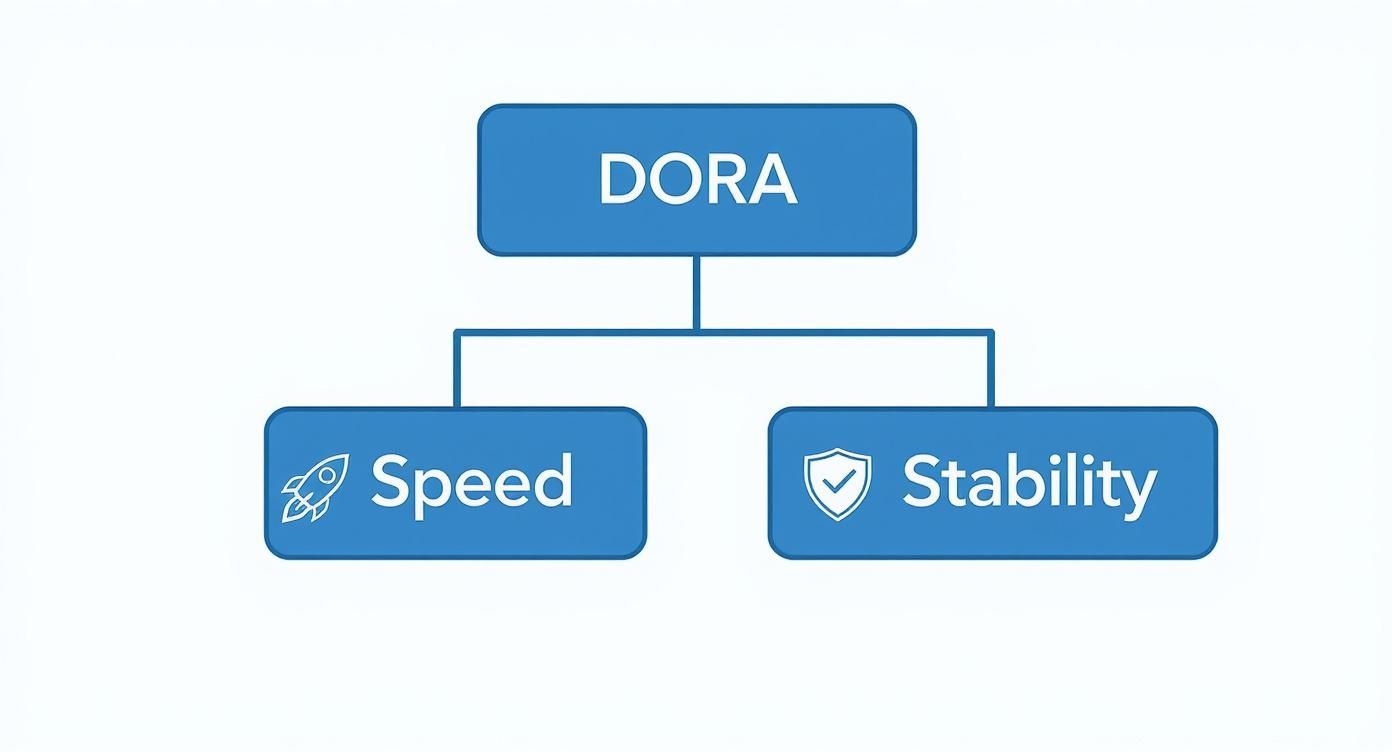
This visual does a great job of showing how productivity is a balancing act. It’s not just about speed; it’s about building stable, reliable software, too.
The Rise of the “Citizen Developer”
It’s hard to overstate just how big this trend is becoming. Projections show that by 2025, a whopping 70% of all new business applications will be built using low-code or no-code tools. The market itself is expected to explode to $187 billion by 2030, which points to a fundamental change in how companies operate. You can discover more insights about software development statistics on designrush.com.
Low-code and no-code platforms act as a productivity accelerant, not by making developers code faster, but by reducing the overall volume of code that needs to be written from scratch.
At the end of the day, these platforms redefine productivity by spreading the ability to build across the organization. It allows companies to be more agile and responsive, with technical experts focused where they add the most value and “citizen developers” handling the rest. The result is a more efficient and innovative company from top to bottom.
The Real Impact of AI on Developer Workflows
AI isn’t some far-off concept in software development anymore—it’s right here, right now. For millions of engineers, tools like GitHub Copilot and other AI coding assistants have become a daily part of the job, integrated directly into their development environment. They’re less like tools and more like partners in the creative coding process.
These AI partners are fantastic at taking over the monotonous, repetitive parts of programming. Need to spin up some boilerplate code? Done in seconds. Stuck on a tricky problem? The AI might just suggest an elegant solution you hadn’t considered. It can even act as a first-pass check for bugs before your code ever hits a formal review.
By automating the small stuff, AI frees up a developer’s brainpower to focus on what really matters: high-level system design and solving the big, meaty problems. But the story isn’t quite that simple. While most developers feel like AI gives them a massive productivity boost, the actual numbers can paint a surprisingly different picture.
The Perception vs. Reality Gap
Everyone expects AI to make development drastically faster, but some fascinating research tells us to slow down. A randomized controlled trial from early 2025 discovered that experienced open-source developers actually took 19% longer to finish their coding tasks when using an AI assistant compared to those who didn’t.
What’s wild is that these same developers expected the AI to make them about 24% faster. Even after taking longer, they still walked away believing the AI had helped them. You can dive into the full research about these surprising AI findings to see just how deep this paradox goes.
This gap shows that early AI tools might be better at improving the feeling of productivity than the actual speed of getting things done. The cognitive offload is real and valuable, but it doesn’t always mean faster output.
This doesn’t mean AI is a bust. Far from it. It just proves that learning to work with an AI is a brand-new skill. Simply having the tool isn’t enough. Developers need to learn how to write good prompts, critically review the AI’s suggestions, and weave it into their workflow without getting distracted. To get good at this, it helps to check out guides on the best AI for writing code and the strategies that make them so effective.
AI as a Force Multiplier
The true power of AI in software isn’t just about speed. It’s about making developers better at what they do and improving the quality of their work. Think of it as a force multiplier.
- Accelerated Learning: A junior developer can use AI like a patient, 24/7 mentor. It can help them get up to speed on a new codebase or even learn a totally new programming language.
- Enhanced Code Quality: AI can suggest more efficient algorithms or point out subtle edge cases a human might overlook, which leads to stronger, more reliable software.
- Reduced Cognitive Load: By handling the grunt work, AI helps developers stay in that deep-focus “flow state” for longer, letting them tackle the toughest challenges with more mental clarity.
At the end of the day, AI isn’t here to replace developers. It’s here to augment them. When you integrate it thoughtfully and measure its impact correctly, it elevates a developer’s ability to build, innovate, and ship high-quality software. The trick is to look past the hype and focus on building a smart, effective collaboration between human and machine.
Overcoming Common Software Productivity Bottlenecks

Even with the best metrics and a team full of talented engineers, hidden roadblocks can bring progress to a grinding halt. Real software productivity isn’t just about speed; it’s about creating a smooth, efficient workflow. The real trick to building a high-performing team is learning how to spot and clear out these friction points.
These bottlenecks are sneaky. They often creep into your processes over time and eventually become “just the way things are done around here.” The key is to start seeing them for what they are: solvable problems that, once fixed, give your team back its most precious resource—time and focus.
Ambiguous Requirements and Scope Creep
So many productivity problems start before a single line of code is ever written. When requirements are fuzzy, incomplete, or constantly shifting, developers are left to fill in the blanks. That guesswork often leads to building the wrong thing entirely, which means a whole lot of wasted time and expensive rework.
Right alongside this is scope creep, that all-too-common situation where new features get tacked on mid-project without any adjustment to the timeline or resources. It’s a recipe for disaster that not only kills momentum but also burns out your developers as they chase a constantly moving target. The only way out is to establish a rock-solid process for defining and managing what you’re building.
- Insist on clear documentation: Every user story needs crystal-clear acceptance criteria before it’s considered ready for development.
- Create a change control process: Set up a formal system to evaluate and approve any changes to the project’s scope once work is underway. No more drive-by feature requests.
- Bring developers in early: Involve your engineers in the planning phase. They’ll ask the tough questions and spot potential problems you might have missed.
Technical Debt
Think of technical debt as the cost of taking shortcuts. It’s what happens when you choose the quick and dirty fix now instead of the better, more sustainable solution that would take a bit longer. It’s like using duct tape on a leaky pipe—it might stop the dripping for a little while, but you’re creating a fragile system that’s a nightmare to maintain down the road.
As this debt piles up, even simple changes can become incredibly difficult and time-consuming. Your team starts spending more time fighting the existing code than they do building cool new features.
A team drowning in technical debt will always struggle with productivity. Dedicating time to pay it down isn’t a distraction from new work; it’s an investment in the ability to do future work efficiently.
The best way to manage this is to be proactive. Make it a rule to allocate a portion of every sprint—a good starting point is 15-20%—specifically to refactoring old code, updating libraries, and cleaning up the system architecture. This keeps the debt from ever spiraling out of control.
Inefficient CI/CD Pipelines
A slow or flaky Continuous Integration/Continuous Delivery (CI/CD) pipeline is a direct tax on your team’s productivity. Every time a developer has to wait 15, 30, or even 60 minutes for a build to finish or for tests to run, that’s valuable time down the drain. These little delays are huge momentum killers, constantly breaking a developer’s flow state and forcing them to switch contexts.
Optimizing your pipelines is one of the highest-impact improvements you can make. By investing in faster build servers, running test suites in parallel, and automating any manual deployment steps, you’re literally giving time back to every single developer with every single commit they make.
Common Questions About Software Productivity
As teams start shifting their focus from just being busy to actually making an impact, a few key questions always come up. Getting clear on what modern software productivity really means helps everyone get on the same page and pull in the same direction. Here are some of the most common ones I hear.
Is Software Productivity Just a Developer Thing?
Not at all. While a developer’s personal workflow—that cycle of writing, testing, and debugging code—is the starting point, real productivity is a team sport. It ripples outward to include product managers defining clear requirements, QA engineers building solid automated tests, and DevOps teams creating smooth deployment pipelines. Everyone has a part to play in getting valuable software out the door.
How Should We Measure Individual Productivity?
This is where a lot of teams stumble. The old way of counting lines of code or number of tickets closed is a trap. Those metrics are easy to game and say nothing about the quality or impact of the work.
Instead, the focus should be on team-based outcomes, like the DORA metrics. When you build a high-performing team, you create an environment where individuals can do their best work. Their collective success is what really matters.
Can We Boost Productivity Without Burning Everyone Out?
Yes, and honestly, that’s the only way it works long-term. This isn’t about pushing people to work longer or faster; it’s about removing the things that slow them down.
Improving productivity means getting rid of clunky, wasteful processes, cutting down the time developers spend waiting for slow builds to finish, and making sure requirements are crystal clear from the start so there’s less rework.
Sustainable productivity is about working smarter, not harder. It’s achieved by investing in better tools, automating repetitive tasks, and protecting developers’ focus so they can solve complex problems without interruption.
When you do this, you actually boost morale and improve work-life balance, which is the foundation of a healthy and effective engineering culture.
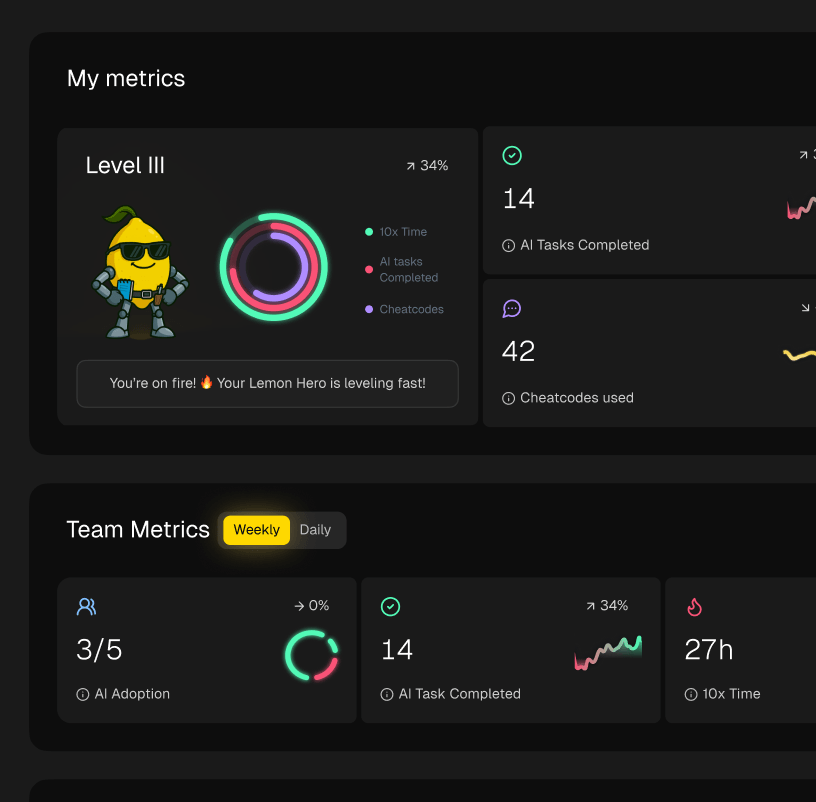
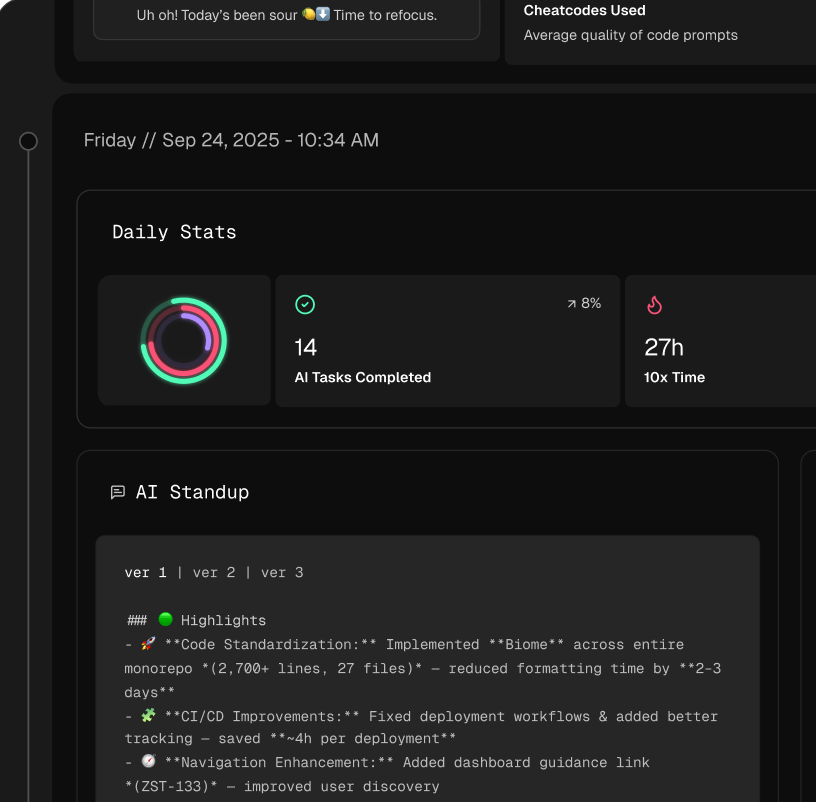
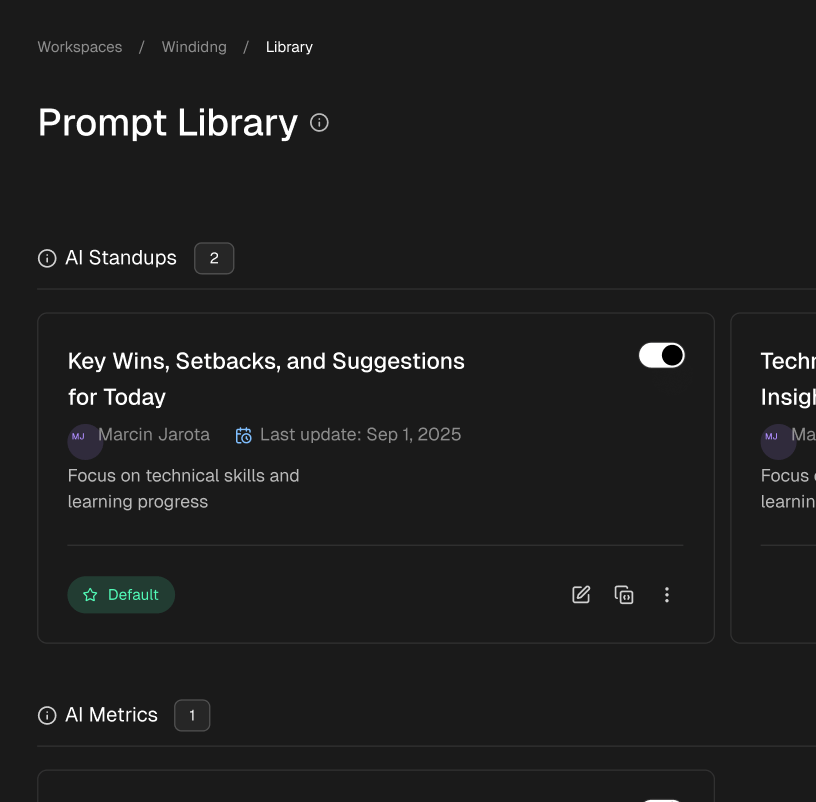
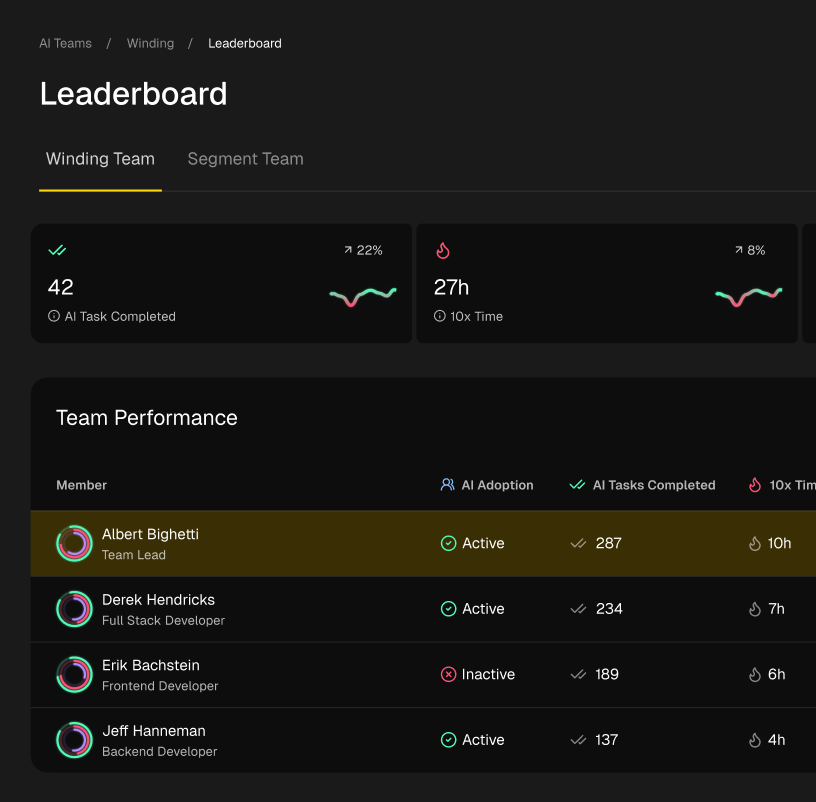
Ready to give your team the insight it needs to turn AI experiments into repeatable wins? With automatic activity tracking, AI Standups, and shared cheatcodes, Zest helps your developers master their AI-assisted workflows and ship faster. Get started with Zest today.
Master Software Productivity
Use this scorecard to shift your team's focus from tracking activity to measuring real-world impact and value.
📊 Core Metrics
- Deployment Frequency — How often do we successfully deliver value to users?
- Change Failure Rate — What percentage of our deployments cause production issues?
- Rework Rate — How much time is spent fixing issues caused by unclear requirements or tech debt?
🕹️ My Cheatcodes
- 🌱 Outcomes Over Output — Prioritize DORA metrics and business impact over lines of code or tickets closed.
- 🦎 Remove Friction, Don't Add Pressure — Optimize CI/CD pipelines and clarify requirements to unblock your team.
- ⚡ Invest in Quality — Dedicate regular time to paying down technical debt to speed up future development.
📈 Reflection Points
- 💡 Are our metrics encouraging the right behaviors or just rewarding busy work?
- 🧩 What is the single biggest bottleneck that slows down our delivery pipeline right now?
- 📘 Does our team feel more effective and less frustrated than they did three months ago? Why?
Gallery
Lemon shots