8 Real-World Project Creep Examples (And How to Stop Them)

Project creep is the slow, often unnoticed expansion of a project’s scope beyond its original goals. It starts with a seemingly small request here and a quick fix there. Before you know it, your timeline is shattered, your budget is gone, and your team is burnt out. This isn’t just a sign of poor planning; it’s a natural pressure that affects even the most disciplined software, product, and AI-assisted coding teams. The key isn’t to prevent all change, but to manage it effectively before it compromises delivery.
This guide moves beyond theory to provide concrete project creep examples that engineering managers, developers, and product teams face daily. For each example, we’ll dissect the common trigger, the observable signs to watch for, and the likely impact on your roadmap. Most importantly, you will get actionable mitigation and prevention tips tailored to the unique challenges of modern development.
We will pay special attention to how these issues show up in AI-centric workflows. The ease of generating new code with AI assistants can accelerate scope expansion if not properly managed. You’ll learn how to identify and control these new forms of creep, ensuring that productivity gains from AI aren’t lost to an ever-expanding workload. This listicle is your tactical playbook for recognizing and stopping project creep in its tracks.
1. The Feature Factory: Endless Feature Requests Without Prioritization
The “Feature Factory” is one of the most common project creep examples, where a project’s scope expands uncontrollably due to a constant stream of new feature requests from various stakeholders. This happens when there is no formal system to evaluate, prioritize, and schedule these requests. Instead, the team is pressured to build everything, turning the product roadmap into a sprawling, unfocused wishlist.

This issue is amplified on teams using AI-assisted coding tools. The speed at which developers can generate code for new features can create a false sense of infinite capacity. For instance, a team building a new AI metrics platform might suddenly face simultaneous demands: managers want custom dashboards, developers ask for integrated cheat-sheet libraries, and the operations team insists on SSO integration. Without a gatekeeping process, the team drowns in low-value work, derailing the core product goals.
Analysis & Mitigation
- Trigger: Unsolicited feature requests arrive from multiple stakeholders via informal channels like Slack, email, or hallway conversations. There is no single point of intake or structured process for new ideas.
- Signs: Your backlog grows faster than your team can complete tasks. Team morale drops as developers feel they are always context-switching and never finishing meaningful work. Core milestones are consistently delayed to accommodate “urgent” new features.
- Impact: The project loses focus, leading to a diluted product that does many things poorly instead of a few things well. Technical debt accumulates as corners are cut to meet the constant demand for new functionality, and the team burns out.
The most effective defense against the feature factory is not to build faster, but to prioritize smarter. Success is measured by the value delivered, not the volume of features shipped.
Prevention Tips
- Implement a formal backlog prioritization process. Use frameworks like RICE (Reach, Impact, Confidence, Effort) or MoSCoW (Must-have, Should-have, Could-have, Won’t-have) to score and rank every request. This data-driven approach removes emotion and politics from decision-making. For a deeper dive, check out these strategies for effective sprint planning with Jira.
- Establish a feature freeze. Set clear periods before a major release where no new features can be added. This protects the team’s focus on stabilization, bug fixing, and polishing the existing scope.
- Create a “parking lot” backlog. Acknowledge good ideas that aren’t a priority right now by moving them to a separate list for future consideration. This validates stakeholder input without derailing current work.
2. Scope Expansion Through ‘Nice-to-Have’ Requirements
This form of project creep is insidious because it happens incrementally, one “small” request at a time. Stakeholders or team members suggest seemingly minor additions, often framed as “nice-to-haves” or quick wins. Individually, each request appears manageable. However, they compound over the project lifecycle, collectively causing significant scope expansion, schedule delays, and budget overruns. This is one of the more subtle but damaging project creep examples.
This problem often starts at the very beginning of a client relationship. A chaotic client onboarding process doesn’t just start projects on the wrong foot; it erodes trust, and creates scope creep by failing to establish clear boundaries from the outset. For example, a team building a new AI-powered standup tool might start with a core scope: basic metrics and automated summaries. Soon, requests trickle in: can it also generate weekly email digests? What about a Slack integration? Then comes custom time-zone support, advanced filtering, and team leaderboards. Each seems like a minor tweak, but together they can easily double the project’s original scope and complexity.
Analysis & Mitigation
- Trigger: Stakeholders propose “just one more thing” during development, often justified as a small improvement or essential for adoption. These requests bypass formal change management processes.
- Signs: The project’s to-do list grows with features that weren’t in the initial plan. You hear phrases like “It should only take a day” or “While you’re in there, could you just…”. The delivery timeline keeps getting pushed back for reasons no one can quite pinpoint.
- Impact: The project’s core value proposition becomes diluted by peripheral features. The development team is constantly diverted from the main goals, leading to a bloated, unfocused product. The cumulative effect of these small additions creates significant technical debt and schedule risk.
Every ‘small’ addition is a tax on focus. The true cost of a nice-to-have feature is not the time to build it, but the distraction it creates from delivering the must-haves.
Prevention Tips
- Define and document a hard scope boundary. Create a clear “in-scope” and “out-of-scope” list in your project charter and keep it visible to the entire team and all stakeholders. Refer back to it whenever a new request is made.
- Require formal change requests. Institute a simple but mandatory change request form for any proposed addition. This forces stakeholders to justify the business value and consider the impact, turning an informal ask into a formal decision.
- Track “scope debt”. Log every approved addition and its estimated impact on time and resources. This creates a running tally that makes the cumulative cost of “nice-to-haves” tangible during project reviews.
- Use velocity metrics to show impact. Show stakeholders how the addition of unplanned work affects the team’s velocity and the delivery date of core features. Visualizing this trade-off helps reinforce the importance of sticking to the plan.
3. Technical Debt Masquerading as Feature Requests
Not all project creep examples come from external stakeholders. Sometimes, it originates within the development team itself when necessary technical work is framed as a new feature. This happens when crucial but invisible tasks like refactoring, database optimization, or infrastructure upgrades are bundled into the feature backlog because there’s no dedicated process for handling them. The result is that planned, user-facing features get delayed as engineering capacity is quietly siphoned off to fix underlying issues.
This problem is common on teams adopting AI-assisted coding. For example, a project might budget for building new AI-powered analytics and leaderboards. However, the development team quickly finds that the existing data pipeline can’t handle the scale of AI metrics being generated. The “feature” of making the pipeline robust suddenly consumes 40% of the sprint’s capacity, derailing the original roadmap. This isn’t a new feature; it’s a discovery of pre-existing technical debt that is now blocking progress.
Analysis & Mitigation
- Trigger: Developers discover that a core system or piece of infrastructure is insufficient to support a new feature. Without a separate track for technical debt, they create a “feature” ticket for the prerequisite work, inflating the project’s scope.
- Signs: Sprint goals are missed due to “unexpected technical challenges.” You see backlog items like “Improve API performance” or “Upgrade database version” competing directly against user-facing story points. Developers express frustration that they can’t build new things on a shaky foundation.
- Impact: The project timeline becomes unreliable as hidden work surfaces continuously. Business stakeholders lose trust in the engineering team’s estimates, and the accumulation of unaddressed technical debt makes future development even slower and more expensive.
Technical improvements are not features; they are investments in the project’s long-term health and velocity. Treating them as such prevents them from silently eroding your roadmap.
Prevention Tips
- Separate technical debt from feature backlogs. Create a distinct backlog or use specific labels (e.g.,
tech-debt,chore) to track and prioritize foundational work. To effectively prevent this issue, it’s critical to understand how to manage technical debt proactively. - Allocate a fixed percentage of each sprint to technical improvements. A common practice is to dedicate 20% of a sprint’s capacity to non-feature work. This creates a predictable budget for refactoring and upgrades without disrupting feature delivery.
- Require clear business impact for technical work. Frame technical tasks in terms of business value. Instead of “Refactor the user service,” use “Reduce user login latency by 50% to improve retention.” This helps product owners prioritize it against other features. For more insights, explore these tips for reducing technical debt.
4. Organizational Alignment Failures: Different Departments, Different Visions
Misalignment between departments is a subtle but destructive form of project creep. This happens when teams have conflicting visions for what a project should achieve, especially with company-wide tools like AI coding platforms. Each department-engineering, product, and operations-pushes for features that optimize its own workflow, pulling the project’s scope in multiple, often incompatible, directions. This turns a unified goal into a tug-of-war for resources and priorities.
For example, imagine a company rolling out Zest for its engineering organization. The developers prioritize features like AI-powered cheat sheets and inline hints to accelerate their daily coding. At the same time, engineering managers demand detailed leaderboards and performance-tracking dashboards. The CTO’s office, focused on governance, insists that enterprise-grade SSO and audit logging are the top “must-have” features. When every group treats its needs as non-negotiable, the project fractures, and its core value proposition is lost.
Analysis & Mitigation
- Trigger: The project kicks off without a single, shared definition of success. Each department independently defines its own success metrics and goals for the project.
- Signs: You hear phrases like “But our team needs…” in every planning meeting. The project backlog is filled with contradictory feature requests. Progress feels slow because the team is constantly context-switching between features that serve different, and sometimes opposing, departmental goals.
- Impact: The project becomes bloated and unfocused, delivering a little bit of value to everyone but not enough to anyone. Budgets and timelines swell to accommodate the competing demands, and inter-departmental friction grows as teams feel their needs are being ignored.
A project without a shared vision is like a ship with multiple captains, each trying to steer it to a different island. It ends up going in circles.
Prevention Tips
- Hold an alignment workshop before kickoff. Bring all key stakeholders together to define and agree upon a single set of shared success metrics. Document these so they can be referenced throughout the project.
- Create a cross-functional steering committee. This group, with representatives from all involved departments, should meet regularly to review progress, make decisions on scope changes, and ensure the project stays aligned with the agreed-upon vision.
- Explicitly document trade-offs. When a decision is made to prioritize one feature over another, clearly state what is being gained and what is being sacrificed. For example, “We will build the SSO integration first to meet security requirements, which means the developer cheat-sheet feature will be moved to the next phase.”
- Phase the rollout. Deliver a core, valuable piece of the project first that serves a common need. Use subsequent phases to add department-specific enhancements, gathering data and feedback along the way to validate true needs versus assumptions.
5. The Integration Spiral: Each Integration Enables More Integrations
The “Integration Spiral” is a deceptive form of project creep where adding one connection to an external service creates a chain reaction of new integration requests. Each new integration doesn’t just add a single capability; it exposes the team to an entirely new ecosystem of potential connections, each with its own set of demands. What starts as a simple link between two systems quickly cascades into a sprawling web of dependencies.
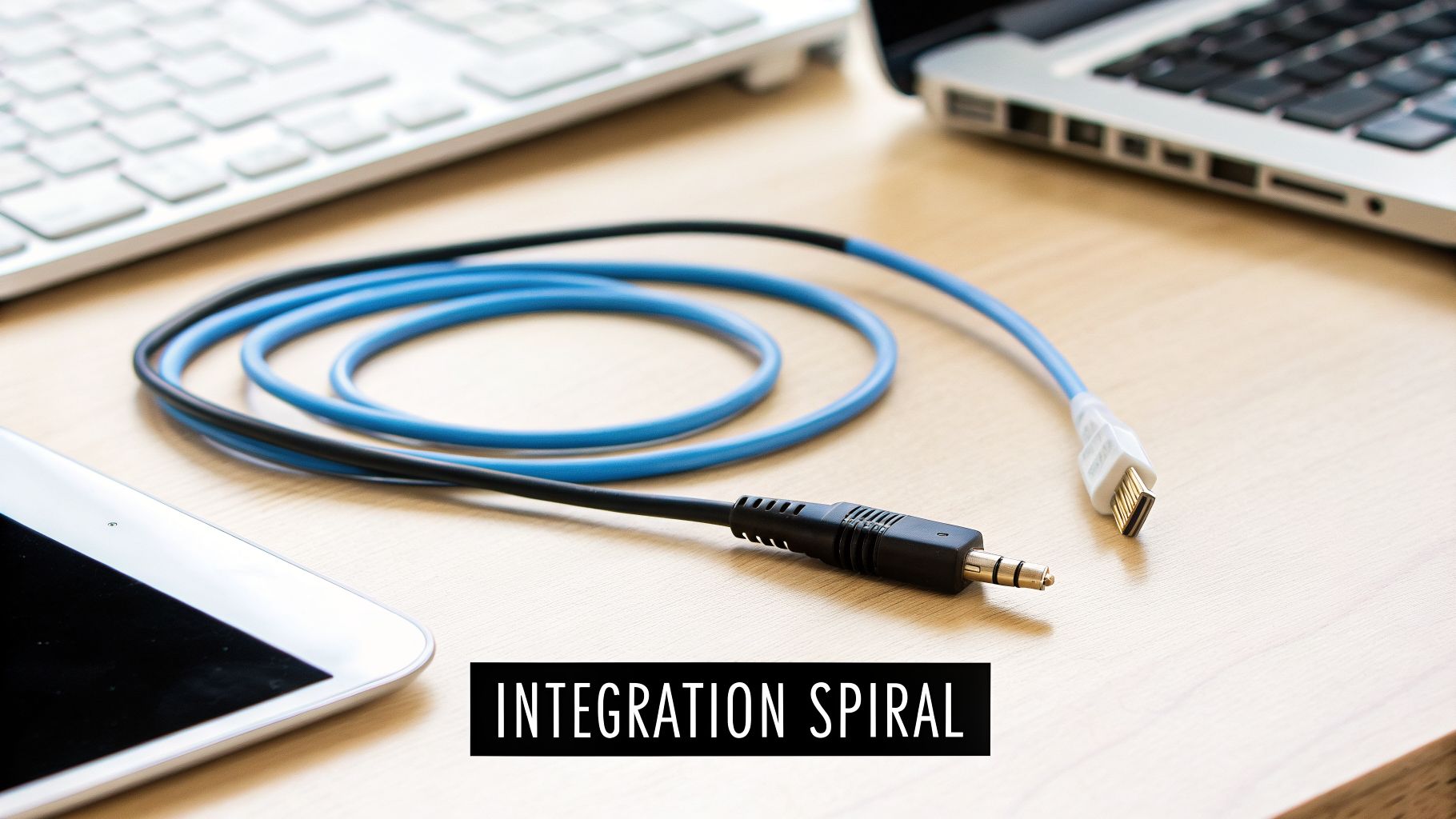
This pattern is especially common for teams building developer tools. For example, a team creates an AI-powered documentation tool and adds a basic GitHub integration to pull in code. Immediately, stakeholders ask for more: Jira task linking, Slack notifications for documentation updates, and VS Code extension support. Each new connection is treated as a “small add,” but collectively they introduce significant maintenance overhead, API versioning issues, and support burdens, pulling focus from the core product.
Analysis & Mitigation
- Trigger: The successful implementation of a single, high-value integration (e.g., Jira, Slack, GitHub) which then opens the door for follow-up requests to connect with related tools in that ecosystem.
- Signs: The product roadmap becomes dominated by third-party integration work. Engineering discussions shift from core feature development to managing API keys, webhooks, and authentication protocols for other platforms. The number of external dependencies grows exponentially.
- Impact: Development velocity on core features grinds to a halt. The team becomes a support hub for third-party tools, and the product’s stability becomes tied to the reliability of other services. This is a subtle but serious project creep example that can derail a product’s primary mission.
An integration is not a feature; it is a product in itself. It requires its own roadmap, support, and justification. Treat it as such, or it will consume your primary product’s resources.
Prevention Tips
- Create a dedicated integration roadmap. Separate integration requests from the main feature backlog. This forces stakeholders to evaluate them as a distinct category of work with its own capacity limits.
- Establish integration guidelines upfront. Define technical standards for how your product will connect with others, including authentication methods, data handling, and error logging. This prevents each new integration from becoming a unique, custom-built project.
- Require a business case for each integration. Before any work begins, the requesting party must document the expected ROI, target audience, and support implications. Only proceed if the value is clearly justified.
- Use abstraction layers. Design a single, internal integration service that can connect to multiple external tools through standardized adapters. This minimizes custom code and makes it easier to add or remove integrations without major engineering effort.
6. Analysis Paralysis: Endless Refinement of Metrics and Measurement
Analysis paralysis is a subtle but destructive form of project creep where the scope expands due to an insatiable demand for data. Teams become obsessed with measuring, analyzing, and reporting on every conceivable metric, continuously expanding what gets tracked. The work required to build the measurement infrastructure eventually overshadows the development of the core product itself, slowing progress to a crawl.

This particular type of project creep example is common in data-rich environments, especially for teams building AI tools. For instance, a team might deliver an AI metrics platform, only to be flooded with follow-up requests: custom time-range comparisons, per-developer productivity trends, time-zone adjusted analytics, and prompt effectiveness scoring. Each new request seems small, but collectively they can double the engineering effort, turning a focused tool into a complex business intelligence suite that was never planned.
Analysis & Mitigation
- Trigger: Stakeholders request “just one more chart” or a new data filter without linking it to a specific business decision or action. The team agrees, believing each addition is a minor effort.
- Signs: The engineering capacity dedicated to analytics and reporting features consistently exceeds 20-30% of the team’s total effort. Dashboards multiply, yet few people can explain what actions to take based on the data. Conversations shift from “what should we build?” to “how can we measure this?”
- Impact: Development on core, value-adding features stalls. The team spends more time building and maintaining analytics than improving the product. This creates a data-hoarding culture where metrics are collected for their own sake, not for actionable insight, leading to widespread burnout and confusion.
The goal isn’t to measure everything you can; it’s to measure what you must. Every metric should be a catalyst for a decision, not just a point of interest.
Prevention Tips
- Define MVP Metrics. At the project’s start, agree on the absolute minimum set of metrics needed to validate the product’s core hypothesis. Defer all other requests until after the initial launch.
- Link Metrics to Decisions. Implement a rule that every new metric request must be accompanied by a clear statement explaining the specific business decision it will inform. If no decision can be identified, the request is rejected.
- Set a Measurement Budget. Cap the amount of engineering time that can be spent on analytics work. A common guideline is to keep it under 20% of the team’s total capacity per sprint or quarter.
- Conduct a Metric Review. On a regular basis (e.g., quarterly), review all existing dashboards and reports. If a metric hasn’t been used to inform a decision in the past quarter, retire it. This keeps the analytics footprint lean and relevant.
7. User Research That Conflicts With Development Timeline
This form of project creep happens when critical user discovery is performed too late in the development cycle. Instead of validating assumptions before writing code, teams dive into building and only later conduct research that reveals fundamental misunderstandings about user needs. This mid-stream conflict forces painful and costly pivots, as the project’s direction must be altered to align with newly discovered truths.
This is a classic example of project creep because it invalidates already completed work. For instance, a team building an AI standups tool might assume developers want daily summaries. After months of development, user interviews reveal that teams actually prefer weekly digests with historical comparisons, and that managers need entirely different content from what developers find useful. This new information requires a significant workflow redesign, UI changes, and backend adjustments, derailing the original timeline and budget.
Analysis & Mitigation
- Trigger: User research is conducted concurrently with or after development has already begun. The findings contradict core product assumptions that were never validated.
- Signs: You hear phrases like “But we already built that part” during feedback sessions. The team is forced to scrap or heavily refactor recently completed features. There is a clear disconnect between what the product does and what test users are trying to accomplish.
- Impact: Development momentum halts as the team is forced to backtrack, leading to wasted effort and a drop in morale. The project timeline and budget inflate significantly to accommodate the necessary rework, and trust between the product and engineering teams can erode.
Assumptions are the silent killers of a project timeline. Validate what your users need before you build, not after you’ve shipped.
Prevention Tips
- Conduct comprehensive user research before development starts. Dedicate a “discovery” phase to interviews, surveys, and competitive analysis to build a solid, evidence-based foundation for the project scope.
- Implement rapid prototyping for early validation. Use low-fidelity mockups or interactive prototypes to test concepts with real users. It is much cheaper to change a design file than it is to rewrite a codebase.
- Document and test all core assumptions. Create a list of every belief the project is built on (e.g., “Users will prefer X over Y”). Design specific, small experiments to validate or invalidate each assumption before committing major development resources.
- Allocate a timeline buffer for adjustments. Even with upfront research, new insights will emerge. Earmark a portion of your schedule, such as 15-20%, specifically for research-driven adjustments and pivots.
8. The Perfectionism Trap: Feature Completeness at Expense of Launch
The “Perfectionism Trap” is a subtle but destructive form of project creep where a team’s pursuit of a flawless feature delays its launch indefinitely. Instead of shipping a “good enough” version and iterating, the team gets caught in a cycle of endless refinement, obsessing over minor UI polish, edge cases, and documentation. The scope expands with each newly discovered “imperfection,” turning the goal of shipping into a moving target.
This trap is especially common on teams building AI-powered tools. A team building an AI Standups feature, for instance, might aim to ship but get stuck continuously refining the summary language, improving time calculation accuracy for obscure timezone combinations, or polishing the UI animations. Each element is declared “almost ready,” but the cumulative “almosts” ensure the feature never actually reaches users, missing its launch window and failing to deliver any value. This is a classic example of project creep where internal quality standards derail external delivery.
Analysis & Mitigation
- Trigger: The team lacks a clear, shared definition of “done.” Without explicit acceptance criteria, developers and designers are left to define quality thresholds on their own, often pushing for an unattainable level of perfection.
- Signs: Launch dates are consistently pushed back for “one last tweak.” The ratio of time spent on core functionality versus polish and edge cases becomes heavily skewed toward the latter. Conversations shift from “What does the user need?” to “What if someone tries this obscure action?”
- Impact: The project gets stuck in development limbo, burning budget and time without generating user feedback or business value. Competitors may launch similar features first, capturing the market. Team morale suffers as the satisfaction of shipping a product is perpetually denied.
The most dangerous enemy of a good plan is the dream of a perfect plan. Ship value, then iterate; don’t chase a flawless v1.0 that never arrives.
Prevention Tips
- Define ‘done’ with explicit acceptance criteria. Before work begins, agree on the exact conditions a feature must meet to be considered complete. This removes ambiguity and sets a clear finish line for the MVP.
- Separate the MVP from post-launch enhancements. Create a clear list of what is required for the initial launch (the MVP) and what can be added later. Stick to this agreement and move all new “nice-to-have” ideas to a v1.1 backlog.
- Use feature flags to de-risk launches. Ship the core feature with the code hidden behind a feature flag. This allows you to deploy the functionality to production while continuing to polish it internally, then enable it for users when it meets the “good enough” standard. This approach is one of the key benefits of agile software development as it prioritizes iterative delivery.
8-Point Project Creep Comparison
| Scenario | 🔄 Implementation Complexity | ⚡ Resource Requirements | 📊 Expected Outcomes | 💡 Ideal Use Cases | ⭐ Key Advantages |
|---|---|---|---|---|---|
| The Feature Factory: Endless Feature Requests Without Prioritization | High — ongoing ad-hoc additions and re-estimation | High — scattered effort across many requests | Bloated roadmap, slowed delivery, unfinished core features | Early-stage ideation when collecting broad input (short-term only) | Captures diverse ideas; keeps stakeholders engaged |
| Scope Expansion Through “Nice-to-Have” Requirements | Moderate → High — many small additions compound | Increasing — cumulative small efforts become large | Scope creep that can double original plan and delay launch | Competitive parity or late-discovered legitimate needs | Addresses late user needs; reduces some post-launch requests |
| Technical Debt Masquerading as Feature Requests | Medium — hidden infra work revealed during dev | High — infrastructure work diverts feature budget | Visible feature delays, improved long-term reliability if done | When system stability or scale is at risk | Prevents future refactors; improves performance and reliability |
| Organizational Alignment Failures: Different Departments, Different Visions | High — conflicting priorities and trade-offs | High — duplicated or incompatible work across teams | Bloated project trying to satisfy all groups; diluted value | Company-wide rollouts needing cross-functional buy-in | Leads to more holistic design and broader buy-in when aligned |
| The Integration Spiral: Each Integration Enables More Integrations | Very High — network effects create exponential complexity | Very High — each integration adds maintenance & support | Exponential scope growth; increased fragility and ops burden | When integrations are central to product value (limited scope) | Improves interconnectivity and automation when controlled |
| Analysis Paralysis: Endless Refinement of Metrics and Measurement | High — measurement infra approaches product complexity | High — analytics effort can dominate development | Slow feature velocity; dashboards may overwhelm users | Critical decisions requiring deep analytics (time-boxed) | Deep visibility and data-driven insight when focused |
| User Research That Conflicts With Development Timeline | Medium → High — pivots require redesign and rework | Medium → High — rework consumes timeline and budget | Better product-market fit but delays and potential rework | When user behavior is uncertain or assumptions are unvalidated | Captures real needs; prevents building the wrong solution |
| The Perfectionism Trap: Feature Completeness at Expense of Launch | High — continuous polishing with unclear “done” | High — time-consuming polishing delays release | Higher quality but delayed time-to-market and missed feedback | Regulated products or when initial UX quality is critical (limited) | Produces polished UX and fewer post-launch bugs when managed |
From Chaos to Control: Your Scope Management Blueprint
We’ve explored a wide range of project creep examples, from the insidious “Feature Factory” to the well-intentioned “Perfectionism Trap.” These scenarios are not isolated incidents of mismanagement; they are predictable patterns that emerge when good intentions collide with a lack of structure. Whether it’s an engineer chasing technical purity, a product manager reacting to every piece of user feedback, or an AI coding assistant making it too easy to add “just one more thing,” scope expansion is a natural force in software development.
The critical insight from these examples is that project creep is rarely malicious. It stems from a desire to deliver value, please stakeholders, or improve quality. The danger isn’t the impulse to add or change something; it’s the absence of a system to evaluate that impulse. Without a framework, small, seemingly harmless additions accumulate, creating a death by a thousand cuts that derails timelines, burns out teams, and bloats the final product.
Shifting from Reactive to Proactive Control
The core takeaway is that you cannot eliminate scope changes, but you can manage them. Moving from chaos to control requires a conscious shift from a reactive posture to a proactive strategy built on three pillars:
- Explicit Communication: Assumptions are the enemy of scope control. Your first line of defense is creating shared understanding through documentation and dialogue.
- Rigorous Prioritization: Not all requests are created equal. A strong prioritization framework ensures that engineering effort is always directed toward the highest-impact work.
- Data-Informed Decision-Making: Gut feelings and stakeholder influence can be powerful, but they must be balanced with objective data about what your team is actually building and what users actually need.
Your Actionable Blueprint for Scope Management
Translating these pillars into action doesn’t require a massive organizational overhaul. It starts with implementing small, consistent habits that build a culture of scope awareness.
- Implement a Formal Change Request Process: This is non-negotiable. Every proposed change, no matter how small, must be documented. This simple act forces a pause, requiring a justification and an assessment of its impact on the timeline and budget.
- Define “Done” Before You Start: For every feature, task, or bug fix, clearly define the acceptance criteria. This creates a finish line that prevents work from drifting into “nice-to-have” territory.
- Separate Workstreams: Avoid the common mistake of bundling different types of work together. Create distinct backlogs or labeling systems for new features, technical debt, and bug fixes. This clarifies priorities and prevents tech debt from masquerading as a new feature request.
- Embrace Timeboxing for Research and Spikes: For tasks with undefined scope, like “Analysis Paralysis” or exploring a new integration, use timeboxing. Allocate a fixed amount of time (e.g., one or two days) to investigate and deliver a recommendation, rather than letting the research expand indefinitely.
By applying these tactics, you transform the narrative. Instead of viewing scope creep as a failure, you begin to see it as a managed process of intentional evolution. The goal isn’t to build a rigid, unchangeable plan but to ensure every deviation from that plan is a conscious, strategic choice that serves the project’s ultimate objectives. This is how you stop being a victim of project creep examples and become the architect of a controlled, predictable, and successful project.
Tired of scope creep derailing your sprints? To truly manage scope, you need visibility into what your team is actually building, including the hidden work driven by AI coding tools. Zest provides that ground truth, analyzing your development data to reveal where time is really going, so you can stop guessing and start managing effectively. See how you can get ahead of project creep at Zest.
Scope Creep Control Scorecard
Use this scorecard to transform project chaos into a managed process of intentional evolution.
📊 Core Metrics
- Unplanned Change Requests — total number of scope changes introduced post-sprint planning
- Feature Bloat Ratio — ratio of "nice-to-have" features vs. core MVP requirements
- Rework Time Percentage — percentage of developer time spent modifying or removing unvetted features
🕹️ My Cheatcodes
- 🌱 Define 'Done' First — establish clear acceptance criteria before writing a single line of code
- 🦎 Isolate Workstreams — separate backlogs for features, tech debt, and bugs to clarify priorities
- ⚡ Timebox Ambiguity — use fixed time allocations for research spikes to prevent analysis paralysis
📈 Reflection Points
- 💡 Is our change request process followed, or is it just 'process theater'?
- 🧩 How often do we say 'no' or 'not now' to a new feature idea?
- 📘 Did we mistake a stakeholder's suggestion for a hard requirement?
✅ Before Closing a Sprint
- 🔍 Review all merged work against the original sprint goals
- 📊 Quantify any scope changes and their impact on the timeline
- 🧭 Document the 'why' behind any necessary scope additions
- 📈 Update the backlog with deferred 'nice-to-have' items
Gallery
Lemon shots