Software Development Process Improvement: Boost Efficiency and Quality Today

Improving your software development process is really just a structured way of making things run better. It’s a continuous effort to smooth out the bumps, cut out the fluff, and boost the speed and quality of how you build, test, and ship software. The goal is to turn a chaotic, unpredictable development cycle into a well-oiled machine that consistently delivers value.
Why Modern Teams Must Focus On Process Improvement
We’ve all been there: staring down a deadline when a wave of unexpected bugs, a critical miscommunication, or a surprise budget overrun throws everything off track. Too many teams just accept this kind of chaos as part of the job. But the data shows this isn’t just “how things are”—it’s a symptom of a process that’s fundamentally broken.
The numbers don’t lie. A 2023 study found that only 39% of software projects actually hit their original goals. Worse, a staggering 31.1% were canceled outright before they were even finished, flushing countless hours and resources down the drain. The financial picture is just as bleak, with 52.7% of projects blowing their budgets by an average of 189%. These aren’t just small hiccups; they’re massive failures often caused by weak requirements and poor communication from the get-go.
Moving Beyond Survival Mode
This is where software development process improvement stops being a buzzword and becomes a lifeline. It’s about committing to finding and fixing what’s slowing you down, from the first sprint planning meeting to the final push to production. Seeing technology modernization as business reinvention helps frame why this is so critical. This isn’t about adding more meetings or red tape; it’s about building a smarter, more resilient engineering culture.
The goals are simple but have a huge impact:
- Ship Better Products Faster: When you clear out bottlenecks and automate the grunt work, your team can move faster without cutting corners on quality.
- Reduce Frustrating Rework: By improving things like code reviews and automated testing, you catch mistakes early. That means less time spent fixing bugs that never should have made it to production in the first place.
- Build a More Effective Culture: When you focus on getting better every day, it empowers your engineers, encourages collaboration, and creates an environment where people aren’t afraid to learn and adapt.
Ultimately, process improvement is about creating an environment where developers can do their best work. It swaps firefighting for foresight, allowing teams to build momentum instead of constantly battling preventable issues.
And now, new AI tools are bringing a whole new set of possibilities to the table. They can help measure team performance, automate complex workflows, and offer real-time insights that were impossible just a few years ago. By embracing these tools, teams can not only solve today’s problems but also get ahead of tomorrow’s, turning their development process into a genuine competitive edge.
Choosing Your Improvement Framework
Picking a framework to guide your software development process improvement is a bit like choosing the right training plan for a marathon. You wouldn’t use a sprinter’s workout to prepare for a 26-mile race. The right methodology has to match your team’s culture, your goals, and the specific problems you’re trying to fix.
Let’s break down the big three frameworks—Agile, Lean, and Six Sigma—not with dry definitions, but with simple analogies that get to the heart of what they do.
Agile: The LEGO Method
Think of Agile development like building a massive LEGO castle. You don’t try to build the whole thing at once from a rigid, thousand-page instruction manual. Instead, you build it one section at a time—a turret here, a drawbridge there—in short, focused bursts of activity called sprints.
After each sprint, you show your progress to stakeholders. This gives you immediate feedback. What if they decide the turret needs to be taller, or the drawbridge should be a different color? Because you’re working in small, self-contained chunks, making changes is easy. You haven’t committed to a final design, so you can adapt as you go. This constant feedback loop is what makes Agile so powerful for projects where requirements are likely to change.
Lean: The World-Class Kitchen
Now, imagine a Michelin-star kitchen during a hectic dinner service. Every action has a purpose. There’s no wasted motion, no redundant steps, and no unnecessary ingredients. This relentless focus on efficiency is the soul of the Lean methodology.
The head chef (your project manager) is obsessed with eliminating waste. In a kitchen, that’s wasted time waiting for an oven, wasted movement walking across the room for a tool, or wasted food from prepping too much. In software development, this means getting rid of pointless meetings, overly complicated approval processes, and features that users don’t actually want. Lean is all about delivering maximum value to the customer with minimum effort.
Six Sigma: The Swiss Watch Factory
Finally, picture a factory that manufactures high-precision Swiss watches. Every gear and spring must be absolutely perfect. Even the tiniest flaw is unacceptable because it could compromise the entire timepiece. This is the mindset behind Six Sigma—a framework fanatically devoted to quality and consistency.
Six Sigma is all about the data. It uses deep statistical analysis to find and eliminate the root causes of errors. The goal is to make your process so predictable that defects become almost nonexistent—the standard is fewer than 3.4 defects per million opportunities. This makes it perfect for mission-critical systems, like medical software or financial trading platforms, where even a small error can have huge consequences.
The decision tree below shows just how easily a project can go off the rails without a guiding framework to keep it on track.
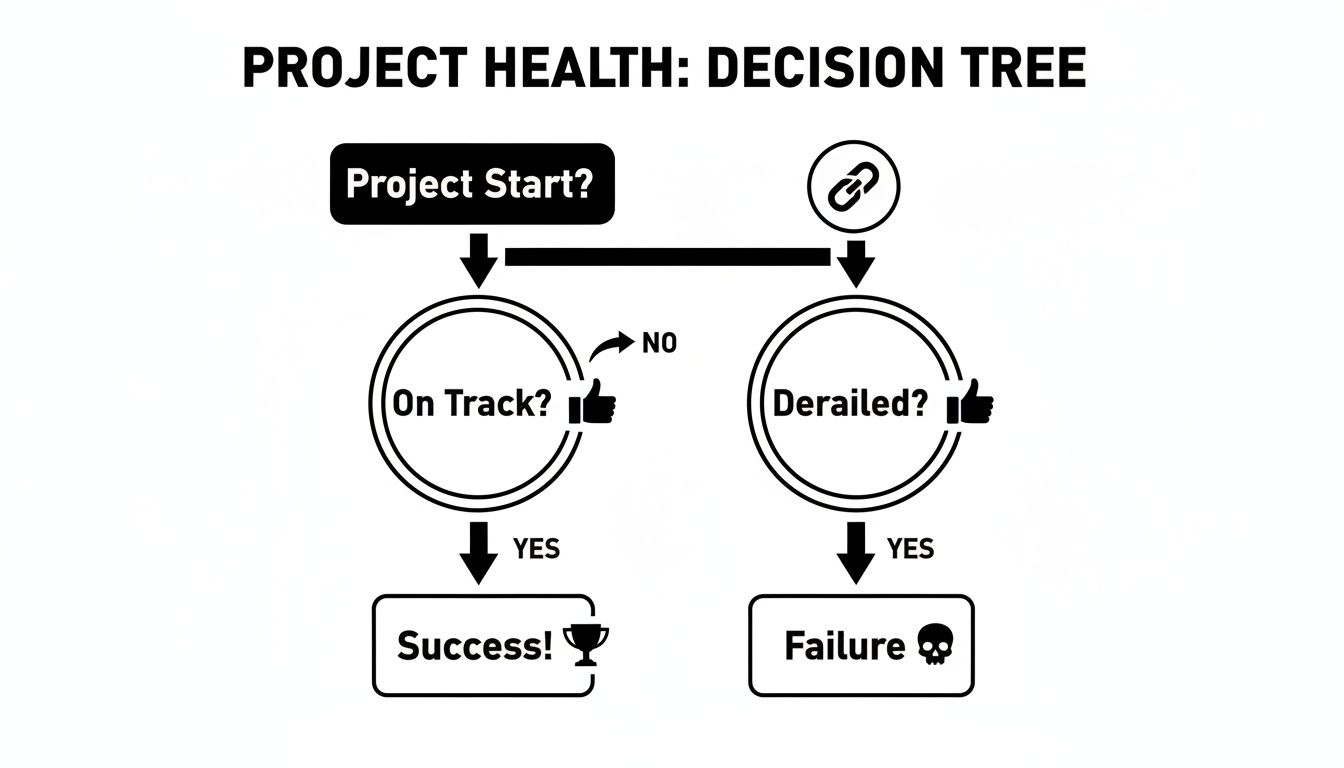
This visual is a stark reminder: without a structured process, projects are just as likely to get derailed or fail as they are to succeed.
Comparing Process Improvement Frameworks
To help you figure out which approach is the best starting point for your team, here’s a quick side-by-side comparison.
| Framework | Core Principle | Best For | Key Metric |
|---|---|---|---|
| Agile | Adaptability and customer feedback | Projects with evolving requirements and a need for speed and flexibility. | Velocity (work completed per sprint) |
| Lean | Eliminating waste and maximizing value | Optimizing existing workflows and increasing delivery speed. | Cycle Time (start to finish for a task) |
| Six Sigma | Reducing defects and process variation | Mission-critical systems where quality and reliability are non-negotiable. | Defect Rate (errors per unit of work) |
Remember, there’s no magic bullet. In the real world, the most successful teams don’t stick rigidly to one framework. They often create a hybrid, borrowing the flexibility of Agile, the efficiency of Lean, and the quality-first mindset of Six Sigma to build a custom software development process improvement strategy that truly fits their needs.
How to Find and Fix Common Bottlenecks
All the frameworks in the world are great in theory, but where the real work begins is on the ground, tackling the obstacles that bring your development process to a crawl. Every engineering team knows these slowdowns intimately. They aren’t abstract concepts; they’re the daily frustrations that kill productivity and team morale.
To get serious about software development process improvement, you have to become a bit of a detective. Your job is to find and fix these common bottlenecks before they can completely derail a project.

Unearthing Codebase Quicksand
We’ve all seen it: that part of the codebase everyone is afraid to touch. Where one small change can set off a chain reaction of bugs. That’s “codebase quicksand,” and it’s the perfect metaphor for the creeping dread of technical debt. This isn’t just an annoyance; it’s a direct tax on your team’s ability to move forward.
Technical debt slows everything to a crawl. Shipping features, fixing issues, and even getting new developers up to speed becomes a painful slog. The only way to escape the quicksand is to first make it visible.
How to Deal With It:
- Track Code Quality Metrics: Start using tools to measure things like cyclomatic complexity (how convoluted your code is), code churn (how often a file changes), and bug density. A complex file with high churn is a massive red flag.
- Conduct Tech Debt Audits: Don’t let technical debt hide in the shadows. Make it a regular part of your sprint planning conversations. Create a dedicated backlog for these issues and chip away at them, just like you would with new features.
- Prioritize Refactoring: Build a culture where leaving the code better than you found it is the standard. You don’t need a massive overhaul; just dedicating 10% of each sprint to paying down debt can make a huge difference over time.
Escaping Communication Black Holes
A “communication black hole” is what happens when crucial information gets lost in silos. The backend team has no idea what the frontend team is building, product managers are vague on requirements, and key context disappears into a messy trail of DMs and email threads.
This lack of clarity leads directly to rework, duplicated effort, and features that completely miss the mark. In fact, one study found that communication issues contribute to failure in a staggering 57% of projects.
A process is only as strong as its lines of communication. When information flows freely and transparently, teams can align their efforts, make smarter decisions, and adapt to changes without missing a beat.
Breaking down these silos requires a conscious effort to change how your team shares information.
How to Deal With It:
- Centralize Your Documentation: Create a single source of truth for everything—project specs, architectural decisions, meeting notes, you name it. Tools like Confluence or Notion are perfect for making sure everyone is on the same page.
- Use Transparent Tools: Get project discussions out of private messages and into public channels on Slack or Teams. This creates a visible, searchable history that benefits the entire team.
- Visualize Your Workflow: A simple Kanban board is one of the most powerful tools for transparency. It makes it instantly clear who is working on what, where things are stuck, and what’s coming next.
Navigating Workflow Whirlpools
Finally, you have the “workflow whirlpools.” These are the endless cycles of inefficient meetings, manual chores, and bureaucratic hoops that suck time and energy away from actually writing code. Engineers feel like they’re just spinning their wheels.
These small inefficiencies are often just accepted as the “cost of doing business,” but they add up to a massive drain on your team. Learning how to calculate cycle time is a great first step, as it helps you pinpoint exactly where these delays are happening.
How to Deal With It:
- Automate Everything You Can: Look for repetitive tasks in your workflow and automate them. This means CI/CD pipelines for testing and deployment, automated code formatters, and scripted environment setups.
- Conduct a Meeting Audit: For one week, track every meeting’s purpose, attendees, and outcome. You’ll be surprised how many can be cut, shortened, or simply replaced with a quick, asynchronous update.
- Streamline Code Reviews: Create clear guidelines for pull requests, keeping them small and focused. Use automated linters and style checkers to catch the easy stuff before a human reviewer ever has to look at it.
By hunting down and fixing these three common bottlenecks, you can turn your development process from a source of frustration into a powerful engine for shipping great software.
Using Data to Guide Your Improvements
You can’t fix what you can’t see. Trying to improve your software development process without data is a bit like driving with a blindfold on—you might be moving, but you have no idea if you’re headed for a ditch. This is why data is your single most powerful tool. It turns gut feelings and “I think we should…” into hard evidence, shifting the conversation from subjective debates to objective, forward-thinking problem-solving.
Let’s be clear: metrics aren’t about micromanagement or creating a developer leaderboard. That’s a surefire way to kill morale. The real point is to illuminate the system, not to judge the people working within it. Good metrics give the team a shared language to talk about performance, spot friction, and actually measure whether the changes they make are working.
Making Your Delivery Health Visible
Before you can improve, you need to know where you stand. The DORA (DevOps Research and Assessment) metrics have become the gold standard for a reason—they offer a balanced look at both speed and stability. Think of them as the vital signs for your engineering team.
Here are the four key metrics:
- Deployment Frequency: How often do you successfully release code to production? A high frequency points to an agile and reliable deployment process.
- Lead Time for Changes: How long does it take from a developer committing code to that code actually running in production? Shorter lead times mean a more efficient, low-friction workflow.
- Change Failure Rate: What percentage of your deployments cause a failure in production? A low rate is a great sign of quality and solid testing.
- Time to Restore Service: When a failure inevitably happens, how long does it take to fix it? A quick recovery time shows your system is resilient.
These numbers give you a clear, quantitative snapshot of your team’s delivery health. You can learn more about DORA metrics in our detailed guide to understand how they tie directly to high-performing teams.
The New Frontier of AI-Driven Insights
While DORA metrics are fantastic for understanding your delivery pipeline, the game is changing. The rise of AI coding assistants has added a whole new layer of activity that traditional metrics just don’t capture. To really get a handle on modern productivity, you have to look beyond just commits and deployments. The next wave of process improvement is all about understanding how your team actually works with AI.
Metrics are for starting conversations, not for ending them. The number itself is just a signal; the real value comes from the discussion it sparks about how to make things better.
New AI-driven metrics offer a much deeper look into the team’s day-to-day workflow. This means you can start tracking things like:
- AI Adoption Rates: Are developers actually using the AI tools they have?
- Time Saved by AI: How much manual, tedious work is being offloaded to assistants?
- Prompt Effectiveness: What kinds of prompts generate the most useful code?
This data helps you understand not just if you’re shipping faster, but why. The impact is already clear. Between 2020 and 2023, AI helped increase characters inserted per keystroke by 41% and lines of code edited per minute by 39%—all while developers were spending less time coding each day. You can explore the full findings on the future of work to see how this technology is reshaping efficiency.
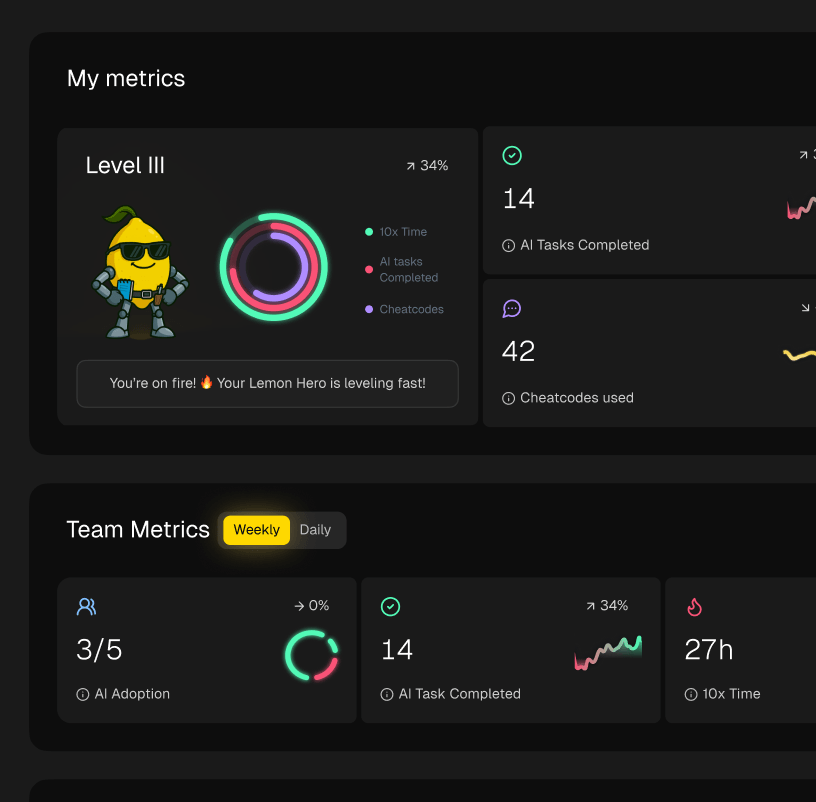
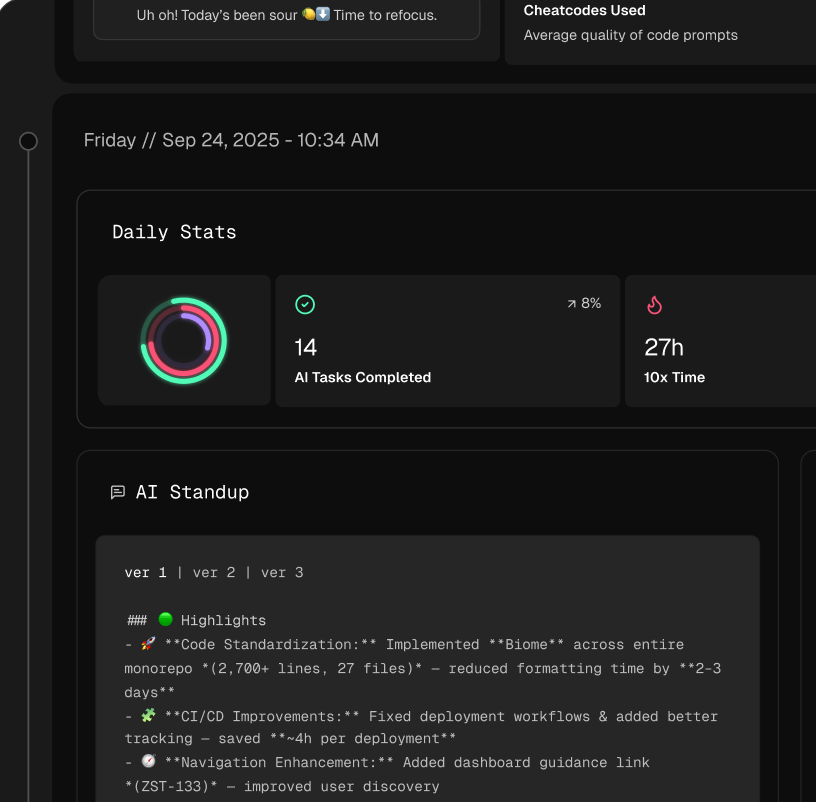
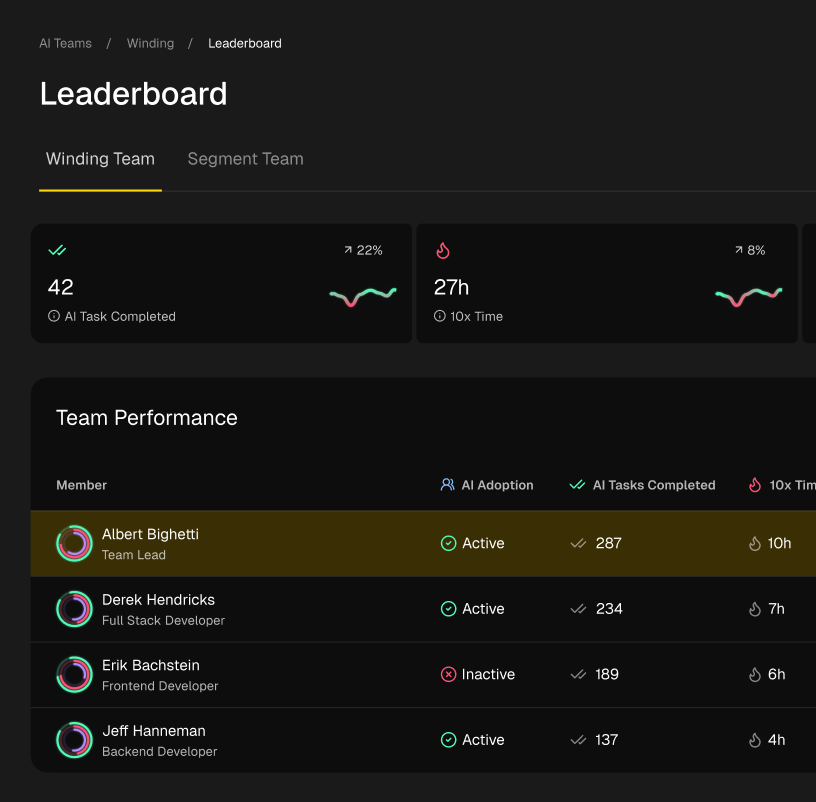
When you collect this kind of data, you can spot patterns, learn from your top performers, and build a playbook of “cheat codes”—effective prompts and workflows that can be shared across the whole organization. This turns individual productivity boosts into a team-wide superpower. Modern platforms can automate this data collection, giving you clear dashboards that empower your teams to make smarter decisions and build a real culture of continuous learning.
Supercharging Your Workflow With AI and Automation
Once you’ve got your foundational frameworks in place and have started tackling bottlenecks, it’s time to add a powerful accelerant: technology. Automation and artificial intelligence aren’t just buzzwords anymore; they’re core components of any serious software development process improvement strategy. These tools don’t just make old workflows faster—they unlock entirely new and more effective ways to build software.

Beyond CI/CD: Infrastructure as Code
Continuous Integration and Continuous Deployment (CI/CD) pipelines were a huge leap forward for development automation, and they’re still absolutely vital. But what’s next? Applying those same principles of automation to the very infrastructure your software runs on. This is the simple but powerful idea behind Infrastructure as Code (IaC).
Instead of a developer manually clicking around in a cloud console to spin up servers, configure databases, or set up networks, IaC lets you define your entire environment in configuration files. Suddenly, your infrastructure becomes versioned, testable, and repeatable—just like the rest of your code. It’s a game-changer. Projections showed that 60% of organizations were looking to bring IaC into their DevOps pipelines, hoping to get a 25% productivity boost.
The Rise of AI Development Partners
While IaC automates the where, AI is completely reshaping the how of coding. AI coding assistants have exploded in capability, moving from fancy autocomplete to what feels like a true coding partner. They can generate entire blocks of code, suggest ways to refactor tricky logic, and even help you talk through a stubborn bug.
These tools are fundamentally changing a developer’s daily grind. They handle the boring, repetitive tasks and offer smart solutions to common problems. This frees up developers to focus their brainpower on the hard, creative work that really matters. To get a feel for how this is playing out across industries, it’s worth reading about AI in the Workplace: From Automation to Collaboration.
The most effective teams don’t just use AI; they build systems to learn from their AI interactions. Capturing what works and sharing that knowledge is the key to scaling productivity.
As AI becomes more embedded in our workflows, it brings new challenges and opportunities. For example, understanding the nuances of AI code review automation is now key to keeping quality high while moving faster. This all points to a bigger question: how do you make sure the whole team benefits from the breakthroughs of your most innovative engineers? The answer is about sharing what works.
Scaling Excellence With AI Cheat Codes
The real magic of AI in development isn’t just about one person getting more done; it’s about making the whole team better. Right now, when a developer figures out a brilliant prompt or a clever way to use an AI assistant, that knowledge usually stays stuck in their head. It’s a personal productivity hack, not a team-wide advantage.
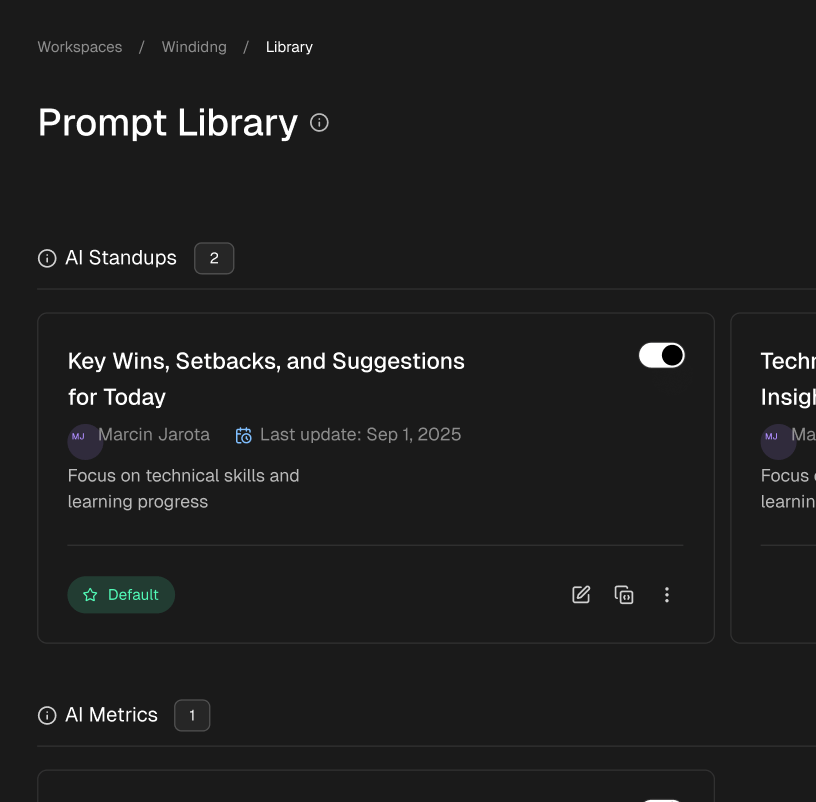
This is where the idea of “cheat codes” comes in. Think of a cheat code as a proven, reusable prompt or workflow that consistently delivers great results from an AI tool. By building a shared library of these cheat codes, your team can:
- Standardize Best Practices: Make sure everyone is using the most effective prompts for common jobs, like writing unit tests or documenting an API.
- Get New Hires Up to Speed Faster: Hand new developers a playbook of proven AI workflows on day one.
- Bottle the Magic of Your Top Performers: Turn the habits of your best engineers into a repeatable process the whole organization can use.
When you start actively managing and sharing these AI interactions, you’re no longer just hoping for individual moments of brilliance. You’re building a powerful, team-wide learning engine that supercharges your entire workflow.
We’re Building a Culture, Not Just a Process
At the end of the day, improving how you build software isn’t a project you can check off a list. It’s a genuine cultural shift. Frameworks like Agile, Lean, and Six Sigma are fantastic tools, but that’s all they are—tools. The real work is creating an environment where everyone is constantly learning and adapting, where getting better is just part of the daily routine.
This shift is what moves a team from constantly fighting fires to proactively preventing them in the first place. It’s about creating a space where engineers feel safe enough to say, “Hey, this part of our process is broken,” without worrying about blame. When a team gets this right, the small, consistent improvements start to snowball, creating a massive impact over time.
Turning Good Ideas into Daily Habits
The trick is to make this cultural change stick by turning abstract goals into things people actually do every day. You have to weave the principles of improvement right into the fabric of your team. This means going way beyond the occasional retrospective and making continuous learning a central part of how you work.
This is the final, and most important, step. It’s where your strategies for fixing bottlenecks, the insights you get from data, and the power of automation all click into place, creating a system that practically runs itself. Suddenly, the focus isn’t just on the process anymore—it’s on the people who make it all happen.
So, how do you pull it all together? Here’s a simple, actionable summary of what truly matters:
- Start by Measuring: You can’t fix what you don’t understand. Start by getting a baseline with key metrics like DORA to get an honest snapshot of where you stand.
- Find Your Biggest Pain Point: Don’t try to boil the ocean. Find the one thing that’s slowing you down the most—whether it’s painfully slow code reviews, vague requirements, or manual testing—and put all your energy there first.
- Experiment with a Framework: Pick a methodology that makes sense for your team’s problems. Whether you need Agile’s flexibility or Lean’s war on waste, use it as a starting point, not a strict set of rules. Be ready to adapt it.
- Give Your Team the Right Tools: Arm your engineers with technology that removes friction. That means solid CI/CD pipelines, helpful AI coding assistants, and platforms that make it easy to document and share what works.
The goal of continuous improvement isn’t to reach some mythical state of perfection. It’s about staying on an exciting, never-ending journey that leads to better products, happier engineers, and a real-deal competitive advantage.
When you focus on these core actions, you create a powerful feedback loop. Better data helps you run smarter experiments. Smarter experiments lead to clear wins. And those wins build the momentum you need to tackle the next challenge, reinforcing the new culture. This is how you stop “improving the process” from being a one-off project and start making it the way you work.
Level Up Your Dev Process
Use these core principles to transform your team’s workflow into a continuous learning engine.
📊 Core Metrics
- Bottlenecks Identified — Number of friction points discovered and addressed.
- Cycle Time Reduction — Percentage decrease in time from task start to completion.
- Process Adherence Rate — How consistently the team follows new best practices.
🕹️ My Cheatcodes
- 🌱 Start Small — Focus on fixing one major bottleneck first to build momentum.
- 🦎 Adapt, Don’t Adopt — Borrow principles from frameworks like Agile and Lean that fit your team.
- ⚡ Empower with Data — Use metrics to guide decisions and prove the value of changes.
📈 Reflection Points
- 💡 Is our team blaming individuals or examining the system when things go wrong?
- 🧩 Are we celebrating the process improvements, not just the feature releases?
- 📘 Do we have a clear, shared understanding of our biggest workflow bottleneck right now?
Frequently Asked Questions
When you start digging into improving your development process, a lot of questions pop up. It’s totally normal. Here are some straightforward answers to the questions I hear most often, designed to help your team get moving.
Where Should Our Team Start First?
Find your biggest pain point and make it impossible to ignore. Seriously, don’t try to boil the ocean by fixing everything at once. Pick a metric—like cycle time or change failure rate—and use it to pinpoint the single biggest bottleneck in your workflow.
Then, focus all your energy there. A small, focused win, like cutting down the time code sits waiting for review, builds the confidence and momentum you need to tackle bigger challenges later.
How Do We Get Buy-In From Skeptical Engineers?
Engineers have a healthy skepticism for anything that smells like corporate bureaucracy or change for the sake of change. The secret to getting them on board isn’t authority; it’s data.
Instead of just telling them there’s a problem, show them. Present the numbers that prove it. For example, you could show that 70% of recent production bugs trace back to one specific module or that vague requirements are causing a ton of rework. When developers see how a process change solves a real headache they deal with every day, they’ll get behind it.
Which Framework Is The Best?
This is a trick question. There is no single “best” framework. The right one for you depends entirely on what your team is trying to solve.
- Agile is fantastic when you’re navigating projects with fuzzy or changing requirements.
- Lean is your go-to when the main goal is shipping value to users as fast as possible.
- Six Sigma is the right call for systems where quality and reliability are non-negotiable.
The best teams I’ve seen don’t follow one framework by the book. They create their own hybrid, cherry-picking principles that work for their situation and ditching the rest. The goal is real improvement, not perfect adherence to a textbook.
How Do We Measure Success?
You measure success with cold, hard data. Don’t rely on gut feelings. Use established metrics to track your progress and prove that your changes are actually working.
The DORA metrics are a great place to start. They track Deployment Frequency, Lead Time for Changes, Change Failure Rate, and Time to Restore Service. Together, they give you a balanced look at both your team’s speed and its stability. Watching these numbers trend in the right direction over time is how you’ll know if you’re truly making a difference.
Ready to put these ideas into practice? Zest helps engineering teams measure and improve their AI-assisted coding workflows. It gives you the data you need to spot bottlenecks and scale what works. Learn how Zest can supercharge your development process.
Optimize Your SDLC Workflow
Turn process improvement from a one-off project into a continuous, data-driven culture.
📊 Core Metrics
- Cycle Time Reduction — The percentage decrease in time from code commit to production release.
- Change Failure Rate — The percentage of deployments causing a production issue (goal: trend down).
- Bottlenecks Resolved — The number of significant workflow friction points identified and eliminated.
🕹️ My Cheatcodes
- 🌱 Start with Pain — Identify and fix your single biggest bottleneck first to build quick momentum.
- 🦎 Adapt, Don't Adopt — Borrow principles from frameworks like Agile and Lean, but customize them for your team.
- ⚡ Lead with Data — Use objective metrics like DORA to justify changes and measure success.
✅ Before Committing to Changes
- 🔍 Get a baseline measurement of your key metrics.
- 📊 Identify one, and only one, primary bottleneck to attack first.
- 🧭 Ensure team buy-in by showing data, not just making demands.
- 📈 Define what a "successful" improvement looks like in numbers.
Gallery
Lemon shots