The 12 Best Code Review Tools for Developers in 2025

In modern software development, a robust code review process isn’t just a best practice; it’s the bedrock of quality, collaboration, and maintainability. But with teams shipping faster than ever, manual reviews can become a significant bottleneck. The right tools can transform this critical step from a chore into a high-leverage opportunity for learning and improvement, especially when integrating AI assistants into your VS Code or Cursor workflow. This guide cuts through the noise to help you find the best code review tools for your specific needs.
We’ll break down the top platforms and services, from industry-standard version control systems with built-in review features to specialized, AI-powered solutions. Whether you’re a startup engineering manager seeking visibility into AI adoption, a solo developer optimizing your workflow, or a CTO standardizing processes, this list has you covered. We provide a comprehensive, comparative roundup focusing on key features like diff viewers, CI/CD integration, automation capabilities, and AI assistance.
Each option includes a direct link, key feature analysis, pricing details, and “best-for” recommendations to streamline your decision-making. We’ll also offer actionable guidance on choosing and adopting a tool effectively. Beyond selecting the right tools, optimizing your process with a focus on human elements is crucial. For detailed strategies on this, explore these 10 Code Review Best Practices. Our goal is to equip you with the information needed to upgrade your code review workflow, enhance productivity, and ultimately ship better software.
1. GitHub
For most development teams, code review begins and ends with GitHub. As the world’s largest source code host, its pull request (PR) system is the de facto standard for collaborative code review. Its core strength is its tight integration; the review process lives exactly where your code does, eliminating context switching. This makes it one of the best code review tools by default for millions of developers.
The user experience is clean and intuitive. Developers can leave inline comments, suggest specific changes that the author can apply with a single click, or batch comments into a single, comprehensive review. This familiar workflow is powerful enough for massive open-source projects yet simple enough for a solo developer.
Key Features and Use Cases
- Pull Request Reviews: The foundation of GitHub’s review system. Use it for inline commenting, requesting changes, or approving merges. The interface clearly shows diffs, conversation threads, and commit history.
- Branch Protection & CODEOWNERS: Perfect for teams needing to enforce standards. You can mandate that at least one review is required before merging or use a
CODEOWNERSfile to automatically request reviews from specific experts based on which files were changed. - Codespaces Integration: A standout feature for complex reviews. Instead of pulling a branch locally, a reviewer can launch a full, cloud-based dev environment with one click to test changes thoroughly without compromising their local setup.
- Copilot AI Integration: With a separate subscription, GitHub Copilot can summarize pull requests and comment threads, helping reviewers quickly get up to speed on large or complex changes.
While GitHub’s core review features are free, advanced functionality like detailed code scanning and SAML SSO are gated behind its paid Team ($4/user/month) and Enterprise tiers. The powerful Copilot AI features also require an additional subscription.
2. GitLab
For teams seeking a single, unified platform for the entire software development lifecycle, GitLab is a top contender. It positions itself as a comprehensive DevSecOps platform, where code review is just one tightly integrated piece of a larger puzzle that includes source control, CI/CD, and security scanning. Its core review mechanism, the Merge Request (MR), is conceptually similar to GitHub’s Pull Request but benefits from deeper native integrations with the rest of the GitLab ecosystem.

This all-in-one approach makes GitLab one of the best code review tools for organizations aiming to reduce toolchain complexity. Instead of stitching together separate services for code hosting, CI, and review, teams get a single, coherent experience. This is especially valuable in regulated industries or large enterprises where consistent governance and process enforcement are critical.
Key Features and Use Cases
- Merge Request Reviews: The central feature for code review. It supports inline comments, threaded discussions, and clear diff views. MR widgets display CI/CD pipeline status, security scan results, and code quality reports directly within the review interface.
- Approval Rules & CODEOWNERS: Ideal for enforcing strict review policies. You can configure rules requiring a specific number or type of approvals before a merge is allowed. The
CODEOWNERSfeature ensures the right experts are automatically assigned to review changes in their areas of ownership. - Multi-assignee Reviewers: Available in paid tiers, this allows you to assign an MR to multiple people, clarifying accountability and ensuring comprehensive feedback from different perspectives (e.g., backend, frontend, and QA).
- Suggested Changes: Like GitHub, reviewers can suggest specific code changes directly in a comment. The author can then apply these suggestions with a single click, streamlining the feedback loop and reducing friction.
GitLab offers a free tier with core functionalities, including MR reviews. However, more advanced governance features like multiple approvers, code owner approvals, and security dashboards are reserved for its Premium ($29/user/month) and Ultimate ($99/user/month) tiers. Self-managed deployment options are also available for maximum control.
3. Bitbucket (Atlassian)
For teams deeply embedded in the Atlassian ecosystem, Bitbucket is the natural choice for version control and code review. Its primary advantage is the seamless, native integration with Jira, transforming code review from an isolated engineering task into a fully traceable part of the project management lifecycle. This connection provides unparalleled context, linking commits and pull requests directly to Jira tickets.

The platform offers a clean pull request interface with inline commenting and merge checks to enforce quality standards. Where it truly shines for Jira-centric teams is in workflow automation; you can automatically transition Jira issues as a PR is created, reviewed, or merged. This makes it one of the best code review tools for organizations that prioritize process and traceability above all else.
Key Features and Use Cases
- Jira Integration: The standout feature. Automatically link branches, commits, and pull requests to Jira issues, providing complete visibility for both technical and non-technical stakeholders.
- Pull Request Reviews: A robust system for inline commenting, approvals, and merge checks. You can require a certain number of approvals or successful builds before a merge is allowed.
- Bitbucket Pipelines: Integrated CI/CD that lets you build, test, and deploy directly from your repository. Reviewers can see build statuses directly within the pull request, ensuring changes are verified.
- AI-Assisted PRs: Available in the Premium tier, this feature uses AI to automatically generate titles and descriptions for pull requests based on the commits, helping reviewers quickly grasp the context of changes.
Bitbucket Cloud offers a generous free tier that includes unlimited private repositories for up to five users. The Standard plan starts at $3/user/month, with the Premium plan ($6/user/month) adding advanced features like IP allowlisting and AI assistance.
4. Azure DevOps
For organizations deeply embedded in the Microsoft ecosystem, Azure DevOps provides a powerful, all-in-one solution where code review is a native component of the entire development lifecycle. Its Azure Repos feature offers a robust pull request system that feels immediately familiar to anyone who has used Git, but its main advantage is its seamless integration with the rest of the Azure suite, making it one of the best code review tools for enterprise teams.
The platform connects code changes directly to work items in Azure Boards and build statuses in Azure Pipelines, providing unparalleled traceability from task creation to deployment. While the UI can feel more complex than competitors like GitHub, this depth allows for highly granular control over the review and merge process, which is often a requirement in regulated or large-scale corporate environments.
Key Features and Use Cases
- Pull Request Reviews: The core of its review capabilities, offering inline commenting, threaded discussions, and status updates. Reviewers can approve, approve with suggestions, or reject changes, all within a structured PR interface.
- Branch Policies: A key differentiator for enterprises. You can enforce strict quality gates such as requiring a successful build from Azure Pipelines, mandating a minimum number of reviewers, and checking for linked work items before a merge is allowed.
- Azure AD Integration: Provides centralized identity and access management. This simplifies permissions and automatically assigns reviewers based on team structures defined in Azure Active Directory, ensuring the right people are always involved.
- End-to-End Traceability: Link pull requests directly to user stories or bugs in Azure Boards. This gives every stakeholder, from project managers to QAs, full visibility into why a change was made and how it was validated.
Azure DevOps offers a free tier for small teams (up to 5 users). Paid plans start with the Basic plan at $6/user/month, which includes all the core DevOps services.
5. Perforce P4 Code Review (formerly Helix Swarm)
For teams working with massive monorepos or large binary assets common in game development, media, or silicon design, Perforce Helix Core (P4) is often the version control system of choice. Perforce P4 Code Review (formerly Helix Swarm) is its native, web-based tool designed to handle the unique scale and workflow demands of these environments, making it one of the best code review tools for non-Git-centric teams.

Unlike Git-based platforms, Swarm is purpose-built for the Perforce ecosystem. It supports both pre-commit and post-commit reviews, allowing teams to enforce quality gates before code is even submitted to the mainline. Its real strength lies in its ability to manage reviews for huge files and complex, sprawling codebases where tools like GitHub might struggle.
Key Features and Use Cases
- Pre- and Post-Commit Reviews: Ideal for high-stakes projects. Use pre-commit reviews to validate changes before they enter the stream, and post-commit reviews for asynchronous feedback on already submitted work.
- Customizable Workflows: Swarm allows teams to define their own review lifecycle with tasks, voting, and required reviewer rules. This is perfect for organizations with strict compliance or quality assurance processes.
- Large-Scale Monorepo Support: Its core advantage is performance and stability when reviewing changes in massive, multi-terabyte repositories containing both code and large binary assets like 3D models or video files.
- Enterprise Integrations: Swarm integrates with CI/CD systems, bug trackers (like Jira), and enterprise security protocols such as SSO and MFA, fitting seamlessly into established corporate toolchains.
Perforce P4 Code Review is included with certain Helix Core subscriptions and P4 Cloud plans. However, its tight coupling with the Perforce ecosystem means it is not a standalone solution for teams using Git; adopting it requires running Perforce infrastructure.
6. Gerrit Code Review
Born from Google’s need to manage massive-scale projects like Android, Gerrit is a free, open-source tool built for high-velocity, high-volume code review. It replaces the pull request model with a more granular, patch set-based workflow. This approach treats each commit as a reviewable unit, which is ideal for large enterprises and open-source projects where precise change tracking and rigorous gatekeeping are non-negotiable.
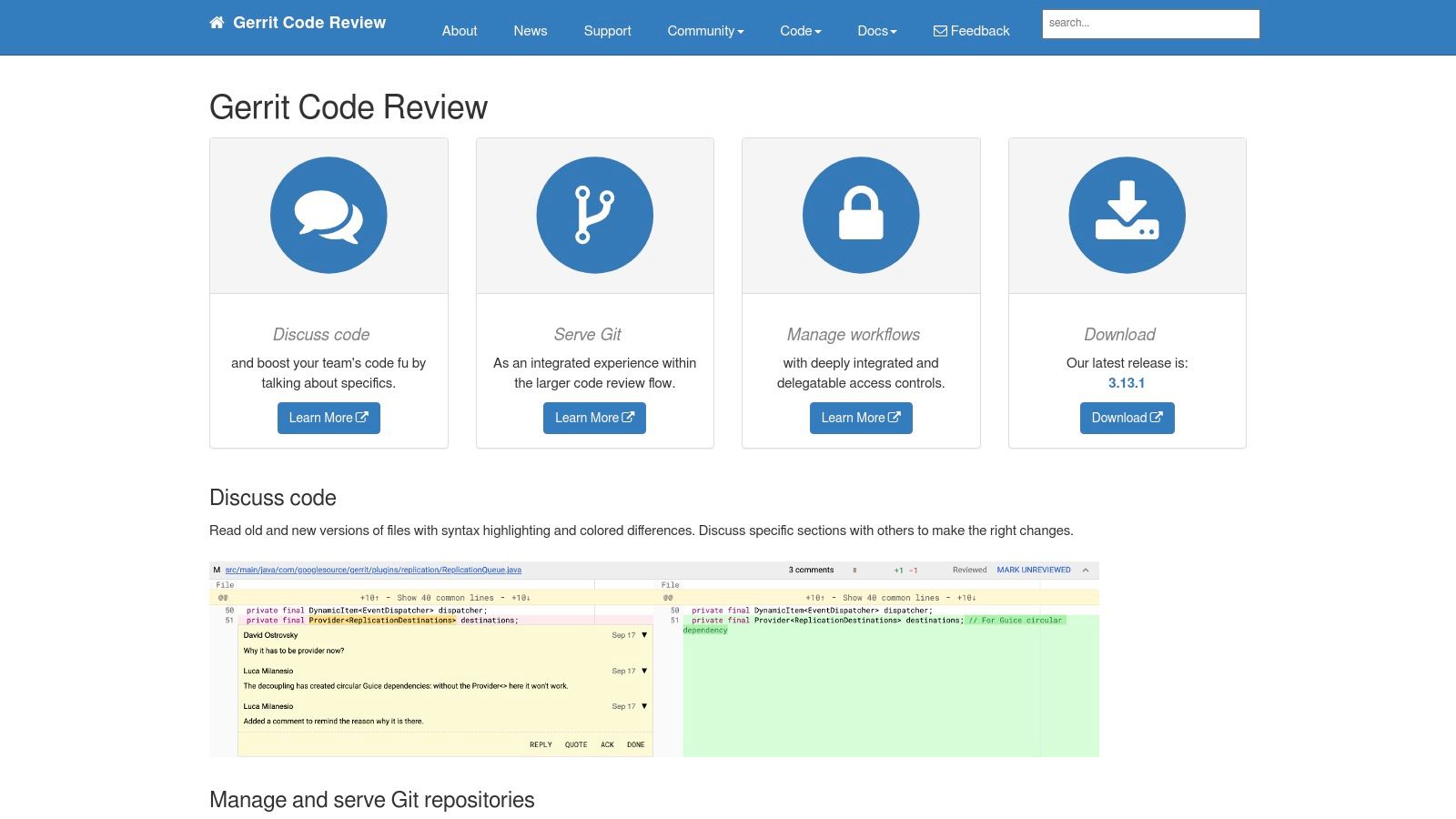
Unlike hosted solutions, Gerrit gives teams total control over their infrastructure and process. While this requires self-hosting and operational expertise, the tradeoff is a highly scalable and customizable system. Its powerful access controls are a key differentiator, allowing organizations to enforce complex permissions and approval workflows that are often impossible with other platforms, making it one of the best code review tools for regulated or security-conscious environments.
Key Features and Use Cases
- Powerful Access Controls: Gerrit’s core strength. Define intricate permissions at the branch level, dictating who can submit, review, and merge changes. This is critical for projects requiring strict quality gates.
- Side-by-Side Diffs: Offers a clean, two-pane view for comparing changes, complete with inline commenting. This user-friendly interface simplifies the process of reviewing complex patch sets.
- Plugin Architecture: Extend Gerrit’s functionality with a rich ecosystem of plugins. Use them for authentication (LDAP, OAuth), CI/CD integration (Jenkins), and connecting with other developer tools.
- Scalability for Large Repos: Built to handle enormous monorepos and thousands of contributors. Its NoteDb backend ensures performance does not degrade, even under the load of projects like Chromium.
Gerrit is completely free to use, as it is open-source software. However, teams must account for the costs associated with self-hosting, maintenance, and the engineering expertise required to manage the platform. Commercial support is available from third parties like GerritForge.
7. Review Board + RBCommons
For teams seeking a powerful, open-source, and self-hosted solution, Review Board offers a mature and highly configurable platform. It stands apart by supporting reviews for more than just code; it handles documents, graphics, and PDFs, making it a versatile quality gate for entire projects. Its flexibility and extensive version control system support (including Git, SVN, Mercurial, and Perforce) make it one of the best code review tools for organizations with diverse or legacy codebases.

The user experience focuses on a pre-commit review workflow, where changes are evaluated before they ever enter the main repository. This approach can help maintain a cleaner commit history. For teams that prefer to avoid the overhead of self-hosting, RBCommons provides the exact same functionality in a managed, cloud-based service, offering a quick path to adoption without infrastructure management.
Key Features and Use Cases
- Multi-VCS & Document Review: Its core strength is its broad support for various version control systems and its ability to review non-code assets like PDFs and design mockups. This is ideal for teams where technical writers and designers collaborate closely with developers.
- Pre-Commit Workflow: Unlike the pull request model, Review Board encourages reviewing changes before they are committed to a central branch. This helps catch issues earlier and prevents broken states from entering the mainline.
- Power Pack Add-on: The optional paid Power Pack extends functionality with enterprise-grade features. Use it for PDF document reviews, advanced reporting to track review metrics, and integration with enterprise SCMs like GitHub Enterprise.
- RBCommons Hosted Service: Perfect for teams that want Review Board’s power without the setup. It provides a managed solution with automatic updates and support, removing the self-hosting burden.
The open-source Review Board is free for unlimited users. The optional Power Pack starts at $299/year for 15 users, while the hosted RBCommons service starts at $10/user/month.
8. SmartBear Collaborator
For teams in regulated industries like aerospace, medical, or finance, code review isn’t just about quality; it’s about compliance. SmartBear Collaborator is a stand-alone, enterprise-grade platform built specifically for this reality. It goes beyond basic diffs by providing a formalized, auditable process for peer reviews of both code and technical documents.
Collaborator’s main strength is its rigorous, process-driven approach. Unlike the more informal pull request systems, it allows teams to enforce detailed custom workflows, use checklists to verify requirements, and capture electronic signatures for formal sign-off. This makes it one of the best code review tools for organizations where traceability and comprehensive audit trails are non-negotiable.
Key Features and Use Cases
- Custom Workflows and Checklists: Ideal for enforcing strict development standards. Teams can build multi-step review processes and require reviewers to complete checklists, ensuring that all compliance and quality gates are met before approval.
- Compliance and Reporting: A critical feature for regulated sectors. Collaborator generates detailed audit trails of every comment, change, and sign-off, providing robust reporting to satisfy auditors and stakeholders. Electronic signatures add a formal layer of accountability.
- Broad SCM & Document Support: It integrates with all major version control systems, including GitHub, GitLab, Azure DevOps, and Perforce. It also uniquely supports peer review for a wide range of documents like design specs, requirements, and test plans.
- Detailed Review Metrics: Provides management with deep insights into review cycle times, defect density, and team participation. This helps identify process bottlenecks and measure the effectiveness of quality initiatives.
Collaborator is a premium, vendor-supported solution. Pricing is not publicly listed and requires a custom quote, reflecting its enterprise focus. This higher cost includes dedicated support, onboarding, and training resources, which can be invaluable for large-scale deployments.
Visit SmartBear Collaborator
9. PullRequest.com
What if your team is stretched thin or lacks specific expertise for a critical code review? PullRequest.com offers a unique solution by providing on-demand access to a network of vetted, experienced engineers. Instead of relying solely on internal capacity, you can route pull requests to external experts who provide high-quality feedback, often with a guaranteed turnaround time. This makes it one of the best code review tools for augmenting your existing team.
It plugs directly into your existing Git workflow on platforms like GitHub, GitLab, and Bitbucket. The service uses AI to identify hotspots in the code, helping its human reviewers focus their attention on the most complex or high-risk areas. This hybrid approach of AI-assisted, human-led review ensures both efficiency and depth, providing a safety net for overworked or understaffed development teams.

Key Features and Use Cases
- Reviewer Marketplace: Gain access to a curated network of senior engineers on-demand. This is ideal for getting a second opinion on critical security features, complex architectural changes, or when your team’s experts are unavailable.
- SLA Turnaround Options: For time-sensitive projects, you can select plans with guaranteed Service Level Agreements (SLAs), ensuring pull requests don’t become bottlenecks waiting for review.
- AI-Assisted Hotspot Surfacing: The platform uses static analysis and AI to flag potential problem areas before a human reviewer even begins. This directs expert attention where it’s most needed, improving the quality and speed of feedback.
- Team Dashboards & Analytics: Managers can track key metrics like review turnaround time, reviewer feedback quality, and common issue types, providing valuable insights into the development process. Combining this with automated code review tools can create a comprehensive quality gate.
PullRequest.com operates on a subscription model, typically priced per developer per month, which can become costly for full team coverage. It’s best utilized strategically to augment, rather than completely replace, an internal review culture.
10. Amazon CodeGuru Reviewer
For teams deeply embedded in the AWS ecosystem, Amazon CodeGuru Reviewer offers automated, machine learning-driven code analysis. It operates by scanning for security vulnerabilities, concurrency issues, and deviations from AWS best practices directly within your existing pull request workflow. Its main value proposition is providing low-overhead, automated feedback that catches common but critical issues before they reach production.

However, it is crucial to note that as of November 7, 2025, CodeGuru Reviewer will no longer allow new repository associations. While existing associations will continue to function, this makes it an unsuitable choice for new adopters. Its inclusion here is for teams who may already use it or are assessing the landscape of automated review tools, where it stands as a key example of platform-integrated, AI-powered analysis.
Key Features and Use Cases
- Automated PR Analysis: The primary use case is automatically scanning pull requests in supported repositories (like AWS CodeCommit and GitHub) and leaving comments with ML-powered recommendations.
- Security & Best Practice Detection: It excels at identifying hard-to-spot issues, such as security vulnerabilities from the OWASP Top 10, resource leaks, and incorrect handling of sensitive data.
- Full Repository Scans: Beyond PRs, you can run a scan on an entire repository to establish a baseline of code quality and security, which is useful for auditing legacy projects.
- Predictable Pricing Model: The service uses a straightforward pricing model based on the number of lines of code (LoC) analyzed per repository, making costs easy to forecast.
Given its pending sunset for new users, CodeGuru is best viewed as a reference for what a tightly integrated, automated review service can offer. Those interested in this workflow can explore how other AI code review tools are filling this niche.
Visit Amazon CodeGuru Reviewer
11. G2
While not a code review tool itself, G2 is an indispensable resource for discovering and vetting them. It’s a software marketplace that aggregates crowdsourced user reviews, making it a critical first stop when creating a shortlist. Its “Peer Code Review” category offers a comprehensive landscape of available tools, helping teams compare options based on real-world feedback rather than just marketing materials.
The platform excels at providing at-a-glance comparisons. You can see how various tools stack up on a grid that plots user satisfaction against market presence, offering a quick read on which products are both popular and well-loved. This data-driven approach is invaluable for validating choices and discovering new or niche solutions that might be a better fit for your team’s specific needs, making it one of the best resources for researching code review tools.
Key Features and Use Cases
- Product Comparison Grids: Use the grids to visually compare tools based on user satisfaction, market presence, and specific features. This helps quickly identify category leaders and promising alternatives.
- Verified User Reviews: Filter reviews by company size, industry, and user role to find feedback from peers in similar situations. This provides authentic insight into a tool’s strengths and weaknesses.
- Category-Specific Filters: Drill down into the peer code review category by filtering for features like automated code review, workflow integration, or static analysis to narrow your search to the most relevant tools.
- Buyer Guides: G2 often provides guides and articles that explain the key considerations when choosing software in a particular category, which can help frame your evaluation process.
Using G2 is completely free for research and discovery. However, be mindful that review quality can vary, and sponsored placements exist, so it’s wise to use it as one of several sources in your evaluation.
Visit G2
12. Gartner Peer Insights
When the primary challenge isn’t just finding a tool but justifying its purchase to stakeholders, Gartner Peer Insights becomes an invaluable resource. Rather than acting as a code review tool itself, it’s an analyst-curated platform providing enterprise-focused reviews and comparisons. For engineering managers and CTOs, this is one of the best code review tools for the research phase, offering a high-level, business-centric view of the market landscape.
The platform provides a trusted, third-party signal that carries significant weight in corporate environments. It helps you understand how tools perform in large-scale deployments, what kind of support to expect, and which vendors are best suited for enterprise needs, moving the conversation from technical features to strategic value and ROI.

Key Features and Use Cases
- Enterprise User Reviews: Gain insights from verified users in similar enterprise environments. These reviews often focus on integration, scalability, and vendor support, which are critical for large organizations.
- Analyst-Curated Content: Access Gartner’s expert analysis and “Magic Quadrant” reports to understand market leaders and their strategic positioning. This is ideal for building a business case for a new tool.
- Product Comparison Views: Use the platform to directly compare vendor offerings based on user ratings and feature summaries. This is useful for creating a shortlist of tools to evaluate further.
- Vendor Overviews: Get detailed information on vendors, their product suites, and their suitability for different organizational sizes and industries, tailored specifically for enterprise buyers.
While browsing is free, accessing detailed reports and some in-depth content requires registration or a Gartner subscription. The volume of reviews is lower than on crowdsourced sites, but the quality and enterprise focus provide a unique and powerful signal for decision-makers.
Top 12 Code Review Tools — Feature Comparison
| Product | Core features | AI & unique features | Target audience | UX / Quality | Price & value |
|---|---|---|---|---|---|
| GitHub | PR reviews, inline comments, Codespaces integration | ✨ Optional Copilot AI summaries, large app marketplace 🏆 | 👥 Dev teams using GitHub repos | ★★★★ — familiar PR UX | 💰 Free → Paid (Copilot extra) |
| GitLab | Merge requests, approvals, CI/CD, CODEOWNERS | ✨ Integrated DevSecOps + approval rules | 👥 Teams wanting all-in-one platform | ★★★★ — end-to-end flow | 💰 SaaS / Self-host; advanced tiers cost more |
| Bitbucket (Atlassian) | PRs, merge checks, Pipelines, Jira traceability | ✨ AI PR summaries (Premium), Jira tie‑ins | 👥 Jira-centric teams | ★★★ — simple admin, tight Jira UX | 💰 Competitive lower tiers; pricing per user |
| Azure DevOps | PR reviews, branch policies, Azure AD integration | ✨ Enterprise identity + Boards/Pipelines link | 👥 Microsoft/Azure enterprises | ★★★ — feature-rich, heavier UI | 💰 Predictable per-user licensing |
| Perforce P4 Code Review | Pre/post-commit reviews, voting, CI hooks | ✨ Scale for large binary/monorepos 🏆 | 👥 Games, media, silicon teams | ★★★★ — enterprise-scale, robust | 💰 Included in some P4 plans; infra cost |
| Gerrit Code Review | Side-by-side diffs, powerful ACLs, plugins | ✨ High-scale, plugin extensible | 👥 Very large repos & OSS projects | ★★★ — proven at scale, steeper learning | 💰 Open-source (self-host) — ops cost |
| Review Board / RBCommons | Inline diffs, multi‑VCS, hosted option | ✨ PDF/docs review + Power Pack addons | 👥 Teams needing flexible VCS support | ★★★ — mature, flexible | 💰 Free self-host; RBCommons paid |
| SmartBear Collaborator | Custom workflows, audit trails, e-signatures | ✨ Compliance-focused reviews & reporting | 👥 Regulated / compliance-driven orgs | ★★★★ — enterprise audit UX | 💰 Higher licensing; vendor support |
| PullRequest.com | On-demand human reviews, dashboards | ✨ AI hotspot surfacing + SLA reviewers | 👥 Teams needing external review capacity | ★★★★ — fast turnaround, vetted reviewers | 💰 Subscription per developer / SLA |
| Amazon CodeGuru Reviewer | PR analysis, repo scans, ML recommendations | ✨ ML-driven security & correctness hints | 👥 AWS-centric teams (existing repos) | ★★★ — low-ops automation | 💰 LoC-based pricing; new repos limited |
| G2 | Crowdsourced reviews, comparison grids | ✨ User sentiment + filters for buyer research | 👥 Buyers shortlisting vendor options | ★★★ — broad market signal | 💰 Free to browse; vendor listings vary |
| Gartner Peer Insights | Analyst-curated enterprise reviews | ✨ Enterprise-focused reviews for stakeholders | 👥 Enterprise buyers/decision-makers | ★★★★ — high-signal, curated content | 💰 Free (some gated content/registration) |
Streamline, Automate, and Elevate Your Code Quality
We’ve explored a wide spectrum of the best code review tools, from the powerful, integrated platforms like GitHub and GitLab to specialized, enterprise-grade solutions such as SmartBear Collaborator and Gerrit. The central theme is clear: the right tool is not a one-size-fits-all solution. It’s the one that seamlessly slots into your team’s existing workflow, addresses your unique challenges, and is actively adopted by your developers.
For many teams, especially those in the startup and mid-market space, the native review features within their version control system are more than sufficient. They provide a low-friction, familiar environment for pull requests, comments, and approvals. However, as teams scale or face stringent compliance requirements, the need for more granular control, detailed reporting, and dedicated review processes often leads them toward specialized tools that offer deeper integrations and more robust feature sets.
Making the Right Choice for Your Team
Selecting your ideal tool requires looking beyond a simple feature list. Consider these key factors as you make your decision:
- Team Size and Workflow: A small, agile team has different needs than a large, distributed enterprise. Does the tool support your branching strategy (e.g., GitFlow, Trunk-Based Development)? Does it create friction or reduce it?
- Integration Ecosystem: The best code review tools don’t operate in a vacuum. Assess how well a potential tool connects with your CI/CD pipeline, project management software (like Jira or Asana), and your developers’ IDEs (like VS Code or Cursor). Deep integration prevents context-switching and streamlines the entire development lifecycle.
- Automation and AI Capabilities: The future of code review is intelligent automation. Tools that leverage AI to catch common bugs, suggest refactoring opportunities, and enforce style guides can significantly reduce the manual burden on senior developers. This allows them to focus on complex logic and architectural feedback rather than syntax nits.
- Analytics and Visibility: For engineering managers and dev leads, understanding the review process is critical. How long do pull requests stay open? Who are the review bottlenecks? Tools that provide insightful metrics are invaluable for process improvement.
Implementing a Tool and Fostering a Review Culture
Adopting a new tool is as much about people and process as it is about technology. True success comes from fostering a positive code review culture where feedback is seen as constructive and collaborative. The tool should support this culture, not hinder it. Ultimately, the goal of code review is to elevate code quality, a cornerstone of successful software development. For a deeper dive into the strategies behind building effective quality assurance teams, explore this guide.
The journey to better code doesn’t end with choosing a tool. It’s about creating a system where quality is a shared responsibility, feedback loops are short, and every review is an opportunity for learning. By pairing the right technology with a healthy engineering culture, you can transform your code review process from a necessary chore into a powerful engine for innovation and excellence.
Ready to gain deep visibility into how your team uses AI in their code review and development workflows? Zest connects to your tools and surfaces the critical metrics you need to optimize productivity and standardize best practices. See how your team reviews code and leverages AI with a free trial of Zest.
Level Up Your Code Reviews
Transform your pull request process into a high-efficiency engine for code quality and team growth.
📊 Core Metrics
- Review Cycle Time — Time from PR creation to merge
- AI-Assisted Fixes — Number of bugs caught by automated tooling
- Code Churn Rate — Percentage of code rewritten post-review
🕹️ My Cheatcodes
- 🌱 Integrate, Don't Isolate — Choose tools that fit your existing CI/CD and IDE workflows.
- 🦎 Automate the Mundane — Let AI handle linting and syntax so humans can focus on logic.
- ⚡ Measure to Improve — Use analytics to identify bottlenecks and optimize review velocity.
📈 Reflection Points
- 💡 Does our current tool create friction or flow for developers?
- 🧩 Are we spending more time on syntax debates than on architectural feedback?
- 📘 How can we use metrics to make our review process faster and more effective?
✅ Before Adopting a New Tool
- 🔍 Map your current review workflow from start to finish.
- 📊 Identify the top 3 bottlenecks you need to solve.
- 🧭 Run a pilot with a small, engaged team first.
- 📈 Define what a successful implementation looks like.
Gallery
Lemon shots